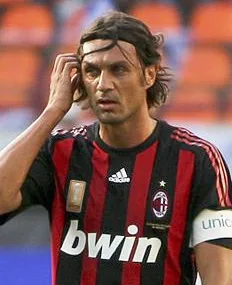
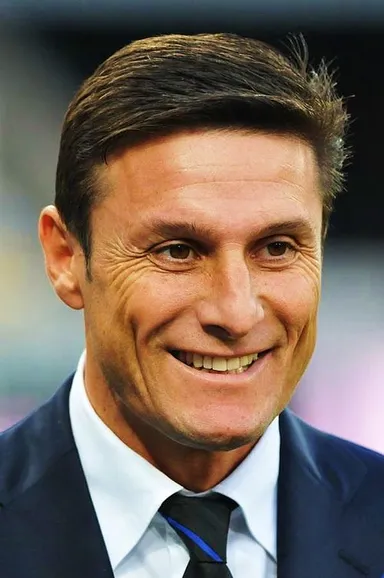
Milan’s one-club defender combined balance, recovery ability and anticipation across left-back and centre-back roles, adapting through twenty-five senior seasons.
Editorial assessment of this period, not an official rating.
Assessment notes & sources
These bands are not percentiles or an overall ranking. The chart’s geometry represents ordered bands, not equal differences in ability.
Qualitative judgments describe football actions in context. They do not measure personality or medical fitness. Category assessments are editorial summaries, not averages. A lower defensive band describes the player’s role and contribution, not their value to the team.
Paolo Maldini makes defensive excellence visible in the choices that precede a tackle. The angle of his approach, the distance he kept from an attacker and the moment he protected a teammate’s space could change an attack before the crowd noticed an intervention. That reading was supported by real athletic ability: the young left-back could travel up the flank and recover at speed, while the experienced centre-back managed the same danger from a different starting position. His importance lies in that combination of technique, movement and judgment. Across Milan’s successive great teams, he had to coordinate with different partners and respond to changing demands, rather than simply repeat one successful routine. The five European titles provide landmarks, but the football between them explains the achievement. Sacchi’s collective pressure, Capello’s compact defence and Ancelotti’s possession structure gave him different problems to solve. For a viewer learning the game, Maldini offers a useful question to ask before every challenge: which space needs protecting, and what happens if the defender leaves it?
Historical references support the chronology; tactical explanations are museum editorial analysis.
Factual senior spells and verified competition scope.
Club career statistical record
Period
Club
Apps
Goals
G/M
1985—2009
AC MilanAC Milan recognises 902 official first-team appearances and 33 goals across twenty-five seasons. The 647 Serie A appearances and 29 league goals are included within that aggregate. He succeeded Baresi as captain in 1997; the armband does not describe every season of the spell.
Senior club · all competitions
Captaincy · #3
902
33
0.04
Sources & methodology
Stored archive snapshots, not live counters. Missing values are not zero; records with different scopes are never added together.
Maldini entered Milan’s first team against Udinese in January 1985, aged sixteen. Sharing a surname with Cesare brought attention, but earning a place required his own work. Under Arrigo Sacchi, his development at left-back became part of a wider transformation: the back line moved with the midfield, and pressure depended on shared distances. Winning the 1988 league title and the next two European Cups placed a young defender inside an exceptional team. The formative lesson was practical. Recovery speed mattered, but knowing when to advance with Baresi and when to protect the space behind the line mattered just as much.
Capello’s Milan asked Maldini to keep control across long league campaigns and decisive European nights. His left-back play combined forward support with the capacity to defend a winger without abandoning the central partnership. In the 1994 European final, Baresi’s suspension helped move him into central defence for the victory over Barcelona. It was evidence of transferable understanding, not a sudden discovery of a second position. That summer ended differently: Italy reached the World Cup final but lost to Brazil on penalties. Club dominance and international disappointment belong together in this period, revealing how even outstanding individual defending depends on collective outcomes.
Maldini succeeded Baresi as Milan captain in 1997, then experienced seasons that were less settled than the team’s great early nineties. The 1999 league title did not remove the need for further rebuilding. With Ancelotti, and increasingly beside Nesta in central defence, he helped give a new midfield a dependable base. His international career ended after the 2002 World Cup, leaving club football as the final arena. In 2003 he appeared throughout Milan’s European campaign, including its qualifying tie. Lifting the trophy after the final against Juventus joined a family story to a fresh achievement: Cesare had captained the winners forty years earlier.
The later Maldini was not permanently confined to centre-back. In the 2005 European final he played on the left and scored the opening goal, before Milan’s lead dissolved and Liverpool won the shoot-out. Remembering that defeat prevents the career from becoming a sequence of inevitable triumphs. Two years later he captained another winning final against the same opponents. The task had shifted towards conserving movement, organising partners and choosing interventions carefully, without removing the need to compete physically. His final season still included thirty league appearances. Retirement in 2009 closed a playing career that had repeatedly adapted while remaining at one club.
Controls the route towards goal through approach angles and balance, then chooses when to engage. Connects with the back line, supports progression from the left and transfers the same spatial reading to central defence.
Balance before interventionOne understanding, different positionsLearn leadership, then renew itLongevity through adjustment
Approach angles and balance
Defensive anticipation
Recovery and line coordination
Positional adaptability
FBCB
Illustrative role zones · not tracking data
Control the attacker’s next option
Maldini’s defensive stance made the next movement manageable. By approaching at an angle and staying balanced, he could narrow the route towards goal without committing every part of his body to the first feint. This is the basis of the anticipation assessment here: the defender shapes the duel before trying to finish it. He could still tackle firmly or slide when the situation demanded it. Patience meant selecting an intervention, not refusing contact or waiting passively for an opponent to make a mistake.
Read the line as a shared responsibility
The left-back had to see more than the winger directly in front of him. When Milan pressed, his position affected the space beside the nearest centre-back and the room available to a runner arriving from midfield. The editorial reading is that his excellence lay in connecting these dangers: stepping with the line, narrowing when the ball travelled away and preparing to turn if pressure failed. Sacchi’s coordinated defence supplied a demanding setting for this skill; it was never simply an individual offside trick.
Advance without losing defensive connection
A naturally right-footed player on the left, Maldini could receive, carry forward and reconnect possession through midfield. His support gave Milan another route beyond pressure, while his crossing offered an option when the outside lane opened. The useful distinction is between technical security and a playmaker’s workload. He helped the team progress, but did not need to supply its entire creative rhythm. His attacking value also depended on timing: an overlap becomes productive when someone can use it and the remaining defence can cover it.
Carry the same judgment into the centre
At centre-back the reference points changed. Rather than defend with a touchline nearby, Maldini had to track threats on either shoulder, judge crosses and coordinate who engaged the forward. His height and timing supported aerial defence, while composure made the first pass after a regain useful. The 1994 final and the later partnership with Nesta show why the transition should be understood as adaptation. Central positioning reduced some long journeys, but increased the cost of a mistaken step directly in front of goal.
His calm appearance came from preparation. A balanced starting position preserved the ability to move again after an attacker’s first action. That is more useful to study than the myth of a defender who never needed to tackle: Maldini’s distinction was often the quality of the choice that made a tackle possible.
One understanding, different positions
Left-back and centre-back exposed him to different spaces, yet both relied on protecting the next route to goal. His return to the flank in later years matters here. It shows that positional evolution was not a one-way retirement plan, but a resource the coach could use when organising the whole defence.
Learn leadership, then renew it
Following Baresi meant inheriting an example rather than merely accepting an armband. Maldini’s later reflections emphasised what he learned from that predecessor about handling strong personalities. His own captaincy then had to serve new teammates and coaches. Continuity worked because the responsibility could be renewed as the dressing room changed.
Longevity through adjustment
Twenty-five seasons should not be read as twenty-five identical physical profiles. The young full-back’s running and the senior centre-back’s management of space belong to different versions. Preserving that distinction gives the career its depth: he kept finding ways to contribute without needing every earlier strength to remain unchanged forever.
This version highlights the running and collective timing that helped Milan compress the pitch. A young Maldini had to join the advance, defend the flank and remain aligned with Baresi’s line. The European Cup win provides the setting; the defining quality is the connection between individual movement and the team’s pressure.
1993/94
The complete defensive reference
Left-back with central defensive responsibility
The shared reference for both rating panels combines mature defensive reading with substantial recovery ability. Capello’s league campaign and the centre-back assignment in Athens illustrate the breadth of the role. The assessment belongs to this season; it does not borrow the captaincy of 2003 or treat the younger defender as physically identical to his later self.
2002/03
The central organiser and captain
Centre-back beside Nesta
Here the emphasis moves towards central spacing, partnership and responsibility over a long European campaign. Maldini played all nineteen matches including the two qualifiers, and lifted the trophy as captain. This version explains how experience and careful positioning could sustain elite contribution while the task differed from his earlier journeys up and down the left flank.
Twenty-five Serie A season rows total 647 appearances and 29 goals. These are league-only figures already contained within the 902-match club record; cups and European competitions are excluded. Assists remain unverified rather than being treated as zero.
Competition record
Club competitions
Competition statistical record
Competition
Apps
Goals
G/M
Serie ASerie A · 1984/85–2008/09Completed league record. This is a subset of the all-competition Milan total, not an additional block of appearances.
647
29
0.04
UEFA Champions LeagueUEFA’s Champions League-era tally · 1992/93–2007/08UEFA lists 109 Champions League-era appearances and separately notes nineteen in the earlier European Cup. The displayed 109 is not his combined European Cup/Champions League career total. Other European competitions are also outside this row.
109
3
0.03
Sources & methodology
Stored archive snapshots, not live counters. Missing values are not zero; records with different scopes are never added together.
Italy’s federation recognises 126 appearances and seven goals. Four World Cups brought third place in 1990 and a runners-up finish in 1994; three European Championships included the 2000 final. His last senior international was the 2002 World Cup defeat by South Korea. He did not win a senior World Cup or European Championship.
Competition record
Senior international · tournament splits
Competition statistical record
Competition
Apps
Goals
G/M
FIFA World CupWorld Cup finals · 1990, 1994, 1998 and 2002Seven, seven, five and four appearances across four finals tournaments. Qualifiers and shoot-outs are outside this match and goal tally.
23
0
0.00
UEFA European ChampionshipEURO finals · 1988, 1996 and 2000Four appearances in 1988, three in 1996 and six in 2000. Qualifying matches are separate; the 2000 runners-up finish is not a title.
13
0
0.00
Sources & methodology
Stored archive snapshots, not live counters. Missing values are not zero; records with different scopes are never added together.
Maldini’s legacy is a way of understanding defence as a sequence of decisions rather than a collection of spectacular recoveries. His career encourages viewers to watch the moment before the ball arrives: the adjusted position, the glance towards a partner and the route an opponent is being invited to take. Those small actions can preserve the shape that allows an ambitious team to attack again. The lesson also has limits. He played with outstanding defenders and within structures built by influential coaches; treating every clean sheet as a solitary achievement would obscure the collective work. Nor should longevity erase the differences between the young runner and the older organiser. What connects them is the ability to keep learning the task. International football adds another perspective, because the World Cup and European Championship finals he reached did not deliver a senior national title. Excellence remained meaningful even when the final result went elsewhere. His enduring place in the game rests on that combination of exceptional standards, adaptation and responsibility to the players around him.