The football behind Javier Zanetti’s ratings
- Control while carrying
- Excellent
- Defensive balance
- Elite
- Reading space around teammates
- Elite
- Endurance and work rate
- Elite
- Secure circulation
- Excellent
- Direct scoring and aerial reach
- Limited
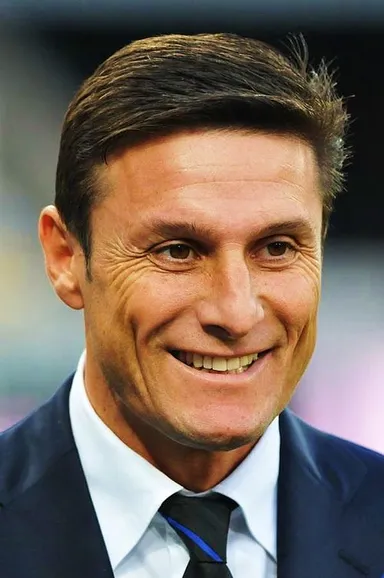 Photo: Илья Хохлов. Source and license in Image credits.
Javier Adelmar Zanetti
A defender and midfielder whose controlled carrying, endurance and positional judgement gave Inter continuity through changing eras.
Senior club · all competitions
Completed club records only; not a complete career total.
Active club snapshots and records with another scope are excluded. Assist totals are not combined across incompatible definitions.
Stored archive snapshots, not live counters. Missing values are not zero; records with different scopes are never added together.
G/M = goals ÷ appearances. G+A = goals + assists. Per-90 metrics use documented minutes.
Senior international · all competitions
Argentina · RSSSF senior register, 1994–2011
Stored archive snapshots, not live counters. Missing values are not zero; records with different scopes are never added together.
G/M = goals ÷ appearances. G+A = goals + assists. Per-90 metrics use documented minutes.
In context
Inter’s number four joined longevity to tactical adaptability, showing how secure possession and selective forward runs could serve a changing team.
Reading the game
Javier Zanetti made reliability an active football skill. He did not merely remain available while more expressive teammates decided matches. He could protect a difficult reception, carry the ball beyond pressure and then leave it with a teammate in a better position. That sequence gave his teams a way to advance without turning every attack into a gamble. His endurance mattered because it let him repeat the work; his judgement mattered because not every available forward run was the right one. Inter’s long association with their number four is the historical setting, but the tactical story extends beyond loyalty. The young wide runner became a defender comfortable on either side and a midfielder able to support a more specialised creator. The 2010 title-clinching assist at Siena and his central role in the European final show different uses of the same controlled approach. This dossier takes 2009/10 as the shared rating reference, with left-back and midfield responsibilities kept visible rather than presenting a fixed right-back role throughout that season. Understanding Zanetti means seeing how continuity, restraint and selective progression can give a changing team room to function.
Historical references support the chronology; tactical explanations are museum editorial analysis.
Historical references: Inter: Zanetti’s Hall of Fame profile ↗ · Inter: Zanetti’s run and assist at Siena in 2010 ↗ · UEFA: analysis of Inter’s 2010 final midfield ↗ · FIGC: Zanetti’s running and defensive qualities ↗
Career
| Period | Club | Apps | Goals | G/M |
|---|---|---|---|---|
| 1992—1993 | Talleres de Remedios de EscaladaTalleres de Remedios de Escalada · league-only spell; check the aggregate for competition coverage. Senior club · league only | 33 | 1 | 0.03 |
| 1993—1995 | BanfieldBanfield · league-only spell; check the aggregate for competition coverage. Senior club · league only | 66 | 4 | 0.06 |
| 1995—2014 | Inter MilanInter Milan · league-only spell; check the aggregate for competition coverage. Senior club · league only Senior · #4 | 615 | 12 | 0.02 |
Stored archive snapshots, not live counters. Missing values are not zero; records with different scopes are never added together.
G/M = goals ÷ appearances. G+A = goals + assists. Per-90 metrics use documented minutes.
Honours
Inter Milan · league
Inter Milan · domestic cup
Inter Milan · domestic cup
Inter Milan · continental
Inter Milan · continental
Inter Milan · world
Javier Zanetti · individual
Story
Career chapter
Zanetti’s senior journey began at Talleres de Remedios de Escalada before two seasons with Banfield brought him to Inter in 1995. His early appeal was visible in the way he carried the ball: successive touches and a strong running base could take him through an opponent’s first challenge without losing control. That ability needed defensive discipline to become useful over a full match. The 1998 UEFA Cup final supplied an early landmark, with his goal contributing to the victory over Lazio. The trophy did not make him the finished veteran overnight; it established a young player whose forward energy could already serve a demanding European team.
Historical references: Inter: Zanetti’s Hall of Fame profile ↗ · Zanetti: league seasons and alternative international record ↗ · UEFA: the 1998 UEFA Cup final ↗
Career chapter
Inter’s path after the UEFA Cup was not a straight ascent. Coaches, attacking partnerships and expectations changed, while Zanetti remained a dependable part of the team. The later domestic successes under Roberto Mancini placed that continuity in a more settled collective. With other players providing width, he could work inside, help connect midfield and cover the space around an advancing teammate. His late equaliser against Roma in February 2008 was a conspicuous intervention in a role often associated with quieter work. The goal mattered in the title race, but it should not turn a selective long-range contribution into a claim that scoring was his normal job.
Historical references: Inter: Zanetti’s Hall of Fame profile ↗ · Inter: Zanetti’s season and competition archive ↗ · Inter: Zanetti’s late equaliser against Roma in 2008 ↗
Career chapter
José Mourinho’s Inter needed Zanetti to solve different problems during 2009/10. At left-back he could protect the flank and choose the moment to carry inside; in midfield he could support Cambiasso and keep a passing connection behind Sneijder. At Siena, his advance and release for Diego Milito helped settle the league title. Six days later, the Champions League final required more central screening and disciplined circulation alongside Cambiasso. These were different assignments within the same team, not evidence that all positions were interchangeable. Inter’s season register records 55 appearances without a goal, a useful reminder that decisive contribution and scoring totals are not the same measure.
Historical references: Inter: Zanetti’s run and assist at Siena in 2010 ↗ · Inter: every player in the 2009/10 treble campaign ↗ · UEFA: the midfield screen in the 2010 European champions ↗ · UEFA: analysis of Inter’s 2010 final midfield ↗
Career chapter
The calendar year of 2010 ended with another international club trophy, the Club World Cup, and Zanetti scored in its semi-final. Further domestic success followed, but Inter could not simply preserve the treble team indefinitely. The later years demanded choices about positioning, recovery and when a forward run still improved the attack. His final season brought a reduced role before the San Siro farewell in May 2014. The completed Inter record reached 858 appearances and sixteen trophies. Those totals describe unusual longevity, yet the football behind them matters more than an image of permanent invulnerability: he remained useful by adjusting his task as both his body and the team changed.
Historical references: Inter: Zanetti’s Hall of Fame profile ↗ · Inter: Zanetti’s season and competition archive ↗ · Inter: the 2010 Club World Cup campaign ↗ · UEFA: Zanetti’s farewell to San Siro in 2014 ↗
Profile
Full-Back
Also plays · Holding Midfielder
The 2009/10 reference uses left-back as its main position, with right-back and central midfield represented as secondary positions. Protect the flank, carry beyond pressure when the lane opens, and screen beside Cambiasso when deployed centrally. These tasks share ball security but require different positioning.
Controlled carrying through pressure
Defensive balance and anticipation
Endurance and repeatable support
Positional judgement and adaptability
Illustrative role zones · not tracking data
Zanetti’s forward running was most valuable when the ball remained available for the next decision. His body could protect it from an approaching opponent while successive touches changed the angle of the challenge. Once the first defender was beaten, he did not have to continue to the byline: a short release could use the space opened for somebody else. The Siena assist is a concrete example of carrying as a way to reorganise the defence before passing, rather than as distance covered for its own sake.
His defensive value was connected to balance and patience. Remaining upright kept recovery options open and made it harder for a winger to remove him from the move with one change of direction. At full-back, the relationship with the nearest centre-back determined how much space he could concede outside. In midfield, the same restraint helped him hold a useful screening position. This reading rewards anticipation and judgement without pretending that he possessed a specialist centre-back’s aerial reach or that every recovery ended in a tackle.
The 2010 final offers a clear division of labour. Zanetti and Cambiasso screened the defence while Sneijder operated as the principal creative link further forward. Safe circulation in that setting had tactical value: it connected the team without asking every receiver to attempt a difficult final pass. Zanetti could help move possession out of pressure and remain ready for the next defensive action. Calling him versatile should preserve these distinctions, rather than imply that he replaced the organiser, creator and ball-winner with one identical role.
Endurance made repeated support and recovery possible, but decision-making gave those runs their purpose. The mature Zanetti did not need to overlap every time the ball reached his flank. Staying behind a teammate could protect a transition; advancing selectively could surprise a defence already occupied elsewhere. His profile therefore values work rate, positioning and ball security more than high-volume crossing or direct goal threat. The occasional spectacular strike belongs in the archive, while the repeated, less visible choices explain a much larger share of his effectiveness.
Historical references: Inter: Zanetti’s Hall of Fame profile ↗ · Inter: Zanetti’s late equaliser against Roma in 2008 ↗ · Inter: Zanetti’s run and assist at Siena in 2010 ↗ · Inter: every player in the 2009/10 treble campaign ↗ · UEFA: the midfield screen in the 2010 European champions ↗ · UEFA: analysis of Inter’s 2010 final midfield ↗ · FIGC: Zanetti’s running and defensive qualities ↗
Reading the game
| Era / team | Primary Role | Tactical Character |
|---|---|---|
| 1992–1995Talleres de Remedios de Escalada / Banfield | Learning to carry in senior football | Develop the balance between forward movement and recovery. |
| 1995–2004Inter Milan | Inter’s durable wide defender | Advance through pressure while keeping the flank connected to the defence. |
| 2004–2008Inter Milan | More work inside the midfield | Support circulation and cover around teammates while retaining full-back options. |
| 2008–2010Inter Milan | Switch between the flank and the screen | Read different defensive reference points at left-back and beside Cambiasso. |
| 2010–2014Inter Milan | Experience and selective progression | Keep useful passing connections and choose forward interventions carefully. |
Historical references: Inter: Zanetti’s Hall of Fame profile ↗ · Zanetti: league seasons and alternative international record ↗ · UEFA: the 1998 UEFA Cup final ↗ · Inter: Zanetti’s late equaliser against Roma in 2008 ↗ · Inter: Zanetti’s run and assist at Siena in 2010 ↗ · UEFA: analysis of Inter’s 2010 final midfield ↗ · UEFA: Zanetti’s farewell to San Siro in 2014 ↗
Reading the game
The distinctive feature of a Zanetti run was often its ending. After gaining ground, he could still choose a simple pass instead of forcing the move through another defender. That joined physical confidence to practical judgement. Teammates could use the space he created because the advance had preserved the ball and a clear connection to the next player.
Left-back at Siena and a central screening role in Madrid demanded different reference points. Zanetti’s value was in recognising those differences and keeping the team’s connections intact. His adaptability was therefore more specific than covering an empty slot: it allowed the coach to alter the supporting structure while retaining a player who understood when to hold or advance.
The captaincy became meaningful because the daily football remained dependable. Offering support, recovering after an attack and accepting a change of role are practical ways to establish a standard for others. The treble was a collective achievement with several decisive performers; Zanetti’s contribution was to help that shared effort remain coherent rather than claim every defining moment for himself.
The Roma equaliser and the Siena assist show two ways to affect a title race. One was a shot after a clearance; the other a carry followed by a release. Neither requires describing him as a prolific scorer. Their importance lies in recognising the opening and having enough technical control to turn an uncommon attacking opportunity into something useful.
Historical references: Inter: Zanetti’s late equaliser against Roma in 2008 ↗ · Inter: Zanetti’s run and assist at Siena in 2010 ↗ · Inter: every player in the 2009/10 treble campaign ↗ · UEFA: analysis of Inter’s 2010 final midfield ↗ · Inter: the captain’s armband at Zanetti’s 700th appearance ↗ · FIGC: Zanetti’s running and defensive qualities ↗
Reading the game
Wide defender with carrying freedom
The 1997/98 version puts carrying and forward energy in the foreground. The UEFA Cup final goal provides a memorable landmark, while the broader role remained about progressing and protecting the flank. It is kept distinct from the older player’s more selective running and central responsibilities.
Full-back and midfield support player
In 2007/08, he played all 38 league matches and could contribute from the flank or midfield. The Roma equaliser captures a selective attacking intervention within a dependable season. This is Mancini’s mature, adaptable player, without importing the later Champions League-winning context.
Left-back and midfield screen
Both assessment panels use the treble-season player, with left-back and central screening assignments explicitly represented. The Siena assist and the European final explain how restraint and progression could coexist. The ratings do not blend youthful running volume with every later-career achievement.
Historical references: Inter: Zanetti’s season and competition archive ↗ · UEFA: the 1998 UEFA Cup final ↗ · Inter: Zanetti’s late equaliser against Roma in 2008 ↗ · Inter: Zanetti’s run and assist at Siena in 2010 ↗ · Inter: every player in the 2009/10 treble campaign ↗ · UEFA: analysis of Inter’s 2010 final midfield ↗ · FIGC: Zanetti’s running and defensive qualities ↗
Statistics
| Season | Club | Apps | Goals | G/M |
|---|---|---|---|---|
| 2013/14 | Inter Milan Senior club · league only | 12 | 0 | 0.00 |
| 2012/13 | Inter Milan Senior club · league only | 33 | 0 | 0.00 |
| 2011/12 | Inter Milan Senior club · league only | 34 | 0 | 0.00 |
| 2010/11 | Inter Milan Senior club · league only | 35 | 0 | 0.00 |
| 2009/10 | Inter Milan Senior club · league only | 37 | 0 | 0.00 |
| 2008/09 | Inter Milan Senior club · league only | 38 | 0 | 0.00 |
| 2007/08 | Inter Milan Senior club · league only | 38 | 1 | 0.03 |
| 2006/07 | Inter Milan Senior club · league only | 37 | 1 | 0.03 |
| 2005/06 | Inter Milan Senior club · league only | 25 | 0 | 0.00 |
| 2004/05 | Inter Milan Senior club · league only | 35 | 0 | 0.00 |
Stored archive snapshots, not live counters. Missing values are not zero; records with different scopes are never added together.
G/M = goals ÷ appearances. G+A = goals + assists. Per-90 metrics use documented minutes.
Twenty-two regular league rows total 714 appearances and seventeen goals, including 33/1 in Argentina’s second tier. Inter’s nineteen Serie A rows total 615/12. They exclude the domestic play-offs bundled into parts of the club archive and use 33 appearances in 2001/02, one goal in 2002/03 and twelve appearances in 2013/14 rather than NFT’s differing entries. The all-competition club aggregate already contains its league subset. All assists remain null. The 2005/06 league title was awarded to Inter after the disciplinary process; it is not presented as an on-field first-place finish.
Club competitions
| Competition | Apps | Goals | G/M |
|---|---|---|---|
Serie ASerie A · regular league matches, 1995–2014The regular league subset of the 858-match Inter career. Domestic play-offs, Italian cups and international club matches are outside this row. | 615 | 12 | 0.02 |
UEFA Champions LeagueChampions League · main competition, 1998–2012UEFA records 97 appearances from the group stage to the final; the wider 105-appearance figure includes eight qualifiers. Both goals were in the main competition. UEFA Cup and Club World Cup matches are separate. | 97 | 2 | 0.02 |
Stored archive snapshots, not live counters. Missing values are not zero; records with different scopes are never added together.
G/M = goals ÷ appearances. G+A = goals + assists. Per-90 metrics use documented minutes.
International
International career
The preferred historical register records 145 appearances and five goals. Zanetti played two World Cups and five Copa América tournaments, reaching the continental final in 2004 and 2007 without winning it. His 1995 Pan American gold and 1996 Olympic silver are age-group achievements, outside the senior record.
National Football Teams: 142 appearances / 4 goals · An alternative 142-cap, four-goal senior series. NFT separately lists the 1995 Slovakia League match as non-FIFA. The preferred RSSSF series also includes fixtures omitted from NFT’s main list; no sum of the two authorities is meaningful.
Senior international · tournament splits
| Competition | Apps | Goals | G/M |
|---|---|---|---|
FIFA World CupWorld Cup finals · 1998 and 2002Five appearances and the England goal in 1998, then three appearances in 2002. Qualifying appearances do not imply selection for the 2006 or 2010 finals. | 8 | 1 | 0.13 |
Copa AméricaCopa América · 1995, 1999, 2004, 2007 and 2011Five tournaments total 22 appearances. The 2004 and 2007 finals ended in defeat to Brazil; no Copa América winner’s title is assigned. | 22 | 0 | 0.00 |
FIFA Confederations CupKing Fahd / Confederations Cup · 1995 and 2005Three appearances in the 1995 predecessor and five in 2005. Argentina finished runners-up at both tournaments. These are already included in the senior total. | 8 | 0 | 0.00 |
Stored archive snapshots, not live counters. Missing values are not zero; records with different scopes are never added together.
G/M = goals ÷ appearances. G+A = goals + assists. Per-90 metrics use documented minutes.
Reading the game
Zanetti’s legacy is strongest when durability is understood as a means of helping a team, rather than a record detached from the game. His long Inter career joined contrasting periods: the gifted runner of the late 1990s, the dependable presence through disappointment, and the experienced captain able to change positions during the treble campaign. The common thread was control over the next action. He could make possession safer without making it passive, and could support an attack without forgetting the space it left behind. That is why his importance cannot be captured by goals or by the number of trophies he lifted alone. The national-team story adds a different perspective. The 1998 England goal remains a major memory, but two World Cups and repeated continental finals did not produce a senior world or continental title. Those limits belong beside the club success. Inter’s retirement of the number four and later Hall of Fame recognition preserve the bond, while the tactical lesson remains available to any team: dependable football requires decisions, technique and an understanding of others, not merely a willingness to keep running.
Historical references: Inter: Zanetti’s Hall of Fame profile ↗ · RSSSF: Zanetti’s 145-cap international register and scope notes ↗ · FIFA: Argentina’s 1998 World Cup match against England ↗ · UEFA: analysis of Inter’s 2010 final midfield ↗ · Inter: the first Hall of Fame inductees in 2018 ↗
Archive
Full-Back · editorial peak 2009—2010
Ottavio Bianchi · Roy Hodgson · Luigi Simoni · Héctor Cúper · Roberto Mancini · José Mourinho · Rafael Benítez · Walter Mazzarri
Ronaldo Nazário— Overlapping Inter Milan era · Luís Figo— Overlapping Inter Milan era · Roberto Baggio— Overlapping Inter Milan era · Roberto Carlos— Overlapping Inter Milan era
Ronaldo in Paris — Inter Milan · The treble — Inter Milan

Cruzeiro · PSV · Barcelona
1993—2011 Photo: Web Summit. Source and license in Image credits.
União São João · Palmeiras · Inter Milan
1991—2016 Photo: Clément Bucco-Lechat. Source and license in Image credits.
Brescia · Inter · Reggina
1995—2017
FC Barcelona · Paris Saint-Germain · Inter Miami CF
2004—Present Photo: Unknown author. Source and license in Image credits.
Argentinos Juniors · Boca Juniors · Barcelona
1976—1997 Photo: Unknown author. Source and license in Image credits.
River Plate · Huracán · Millonarios
1945—1966
AC Milan
1985—2009
Real Madrid Castilla · Real Madrid · Borussia Dortmund
2016—Present
Sporting CP · Paris Saint-Germain
2020—PresentStatistics are displayed only within the scope supported by each cited source.
Inter MilanInter: Zanetti’s Hall of Fame profileInter MilanInter: Zanetti’s season and competition archiveInter MilanInter: Zanetti’s 615 Serie A appearancesNational Football TeamsZanetti: league seasons and alternative international recordBDFutbolBDFutbol: Zanetti’s league match registerRSSSFRSSSF: Zanetti’s 145-cap international register and scope notesUEFAUEFA: the 1998 UEFA Cup finalFIFAFIFA: Argentina’s 1998 World Cup match against EnglandInter MilanInter: Zanetti’s late equaliser against Roma in 2008Inter MilanInter: Zanetti’s run and assist at Siena in 2010Inter MilanInter: every player in the 2009/10 treble campaignUEFAUEFA: the midfield screen in the 2010 European championsUEFAUEFA: analysis of Inter’s 2010 final midfieldInter MilanInter: the captain’s armband at Zanetti’s 700th appearanceInter MilanInter: the 2010 Club World Cup campaignUEFAUEFA: Champions League appearances from the main competitionUEFAUEFA: Zanetti’s farewell to San Siro in 2014Inter MilanInter: the first Hall of Fame inductees in 2018FIGCFIGC: Zanetti’s running and defensive qualitiesOlympediaOlympedia: Zanetti’s Olympic and Pan American medalsUEFAUEFA: Champions League record including qualifiers