

The football behind Andrea Pirlo’s ratings
- Passing range and weight
- Generational
- Pre-reception scanning
- Elite
- Tempo control
- Generational
- Passing disguise
- Elite
- Free-kick technique
- Generational
- Recovery speed
- Limited
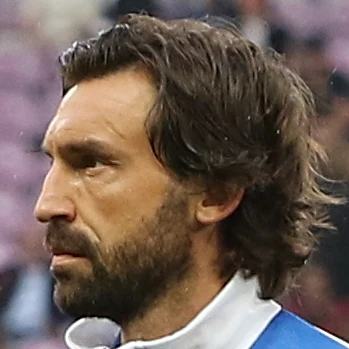 Photo: Clément Bucco-Lechat. Source and license in Image credits.
Andrea Pirlo
A former number ten who learned to direct attacks from deeper midfield, using early observation, passing disguise and exceptional control of distance.
Senior club · all competitions
Completed club records only; not a complete career total.
Active club snapshots and records with another scope are excluded. Assist totals are not combined across incompatible definitions.
Stored archive snapshots, not live counters. Missing values are not zero; records with different scopes are never added together.
G/M = goals ÷ appearances. G+A = goals + assists. Per-90 metrics use documented minutes.
Senior international · all competitions
Italy · completed senior record, 2002–2015
Stored archive snapshots, not live counters. Missing values are not zero; records with different scopes are never added together.
G/M = goals ÷ appearances. G+A = goals + assists. Per-90 metrics use documented minutes.
In context
Pirlo gave deep playmaking a distinct modern expression across Milan, Italy and Juventus, with teammates’ movement turning his passing range into collective progress.
Reading the game
Andrea Pirlo changed where an attack could begin to become dangerous. Receiving in front of the centre-backs, he could see the first pressing line, the midfield behind it and a runner beyond both. A short pass invited an opponent closer; a longer one could remove several defenders from the move. His importance lay in choosing between those possibilities before the ball arrived, then disguising the choice long enough for the receiver to gain an advantage. Moving a former attacking midfielder deeper did not remove creativity from his game. It changed the angle from which he could use it. Brescia supplied an early experiment, Milan built a durable midfield around it, and Juventus later gave it different runners and routes forward. Italy showed the same intelligence in tournament football, especially in 2006 and 2012. Understanding Pirlo also means watching the teammates who protected his space and offered passing options. The regista was a shared arrangement made unusually productive by one player’s perception, touch and range.
Historical references support the chronology; tactical explanations are museum editorial analysis.
Historical references: Juventus: Pirlo’s four seasons, passing and free kicks ↗ · UEFA: Pirlo’s Champions League career and the regista transition ↗ · FIFA: Pirlo’s passing in Italy’s 2006 triumph ↗ · UEFA: Pirlo directs Italy at EURO 2012 ↗
Career
| Period | Club | Apps | Goals | G/M |
|---|---|---|---|---|
| 1995—1998 | BresciaInitial Brescia league spell: 30 Serie A appearances and 17 Serie B appearances, with six goals across those divisions. The 1995/96 league row is a confirmed zero, not missing data. The later loan is shown separately. Senior club · league only | 47 | 6 | 0.13 |
| 1998—2001 | InterInter’s official archive records 22 league, ten European and eight domestic-cup appearances: forty matches without a goal. The Reggina and Brescia loan appearances are not part of this total. Senior club · all competitions | 40 | 0 | 0.00 |
| 1999—2000 | RegginaA Serie A loan with 28 league appearances and six goals. Cup matches are outside this row’s scope, and the loan is not counted again in Inter’s appearances. Senior club · league only Loan | 28 | 6 | 0.21 |
| 2001—2001 | BresciaTen Serie A appearances during the return on loan. Mazzone’s deeper use belongs to this spell; the appearances are separate from both the earlier Brescia stage and Inter’s forty matches. Senior club · league only Loan | 10 | 0 | 0.00 |
| 2001—2011 | AC MilanMilan’s official legend archive gives 401 matches and 41 goals, including 284 Serie A appearances and 32 league goals. The decade contains different roles and availability, rather than one continuous peak. Senior club · all competitions Senior · #21 | 401 | 41 | 0.10 |
| 2011—2015 | JuventusJuventus records 164 appearances, nineteen goals and 35 assists in its farewell retrospective. Fifteen goals were free kicks. The assist figure is retained in the club’s own all-competition scope and is not combined with unverified totals from other spells. Senior club · all competitions Senior · #21Performance record
| 164 | 19 | 0.12 |
| 2015—2017 | New York City FCSixty MLS regular-season appearances and one goal. The season database lists 13, 32 and 15 appearances; these reconcile to the club’s sixty-match headline. Play-off appearances, including the November 2017 farewell, are excluded. Senior club · league only Senior · #21 | 60 | 1 | 0.02 |
Stored archive snapshots, not live counters. Missing values are not zero; records with different scopes are never added together.
G/M = goals ÷ appearances. G+A = goals + assists. Per-90 metrics use documented minutes.
Honours
Brescia · league
AC Milan · league
Juventus · league
AC Milan · continental
AC Milan · domestic cup
Juventus · domestic cup
AC Milan · domestic cup
Juventus · domestic cup
AC Milan · continental
AC Milan · world
Italy · world
Italy Under-21 · continental
Italy · individual
Story
Career chapter
Brescia introduced a technically gifted attacking midfielder, but the move to Inter did not immediately provide a stable senior role. The Reggina loan kept his attacking qualities in view, and two goals in the 2000 Under-21 European final showed his ability near the opponent’s goal. Returning to Brescia on loan brought another possibility. Carlo Mazzone used him deeper, allowing his passing to influence the approach to the final third. This was an important experiment rather than an overnight invention of the finished Milan player. The question became how to give a creative midfielder both a wider view and enough support to use it.
Historical references: Inter: Pirlo’s forty appearances across competitions ↗ · UEFA: Pirlo’s Champions League career and the regista transition ↗ · UEFA: Pirlo’s two goals in the 2000 Under-21 final ↗
Career chapter
Pirlo joined Milan in the summer of 2001, before Ancelotti replaced Fatih Terim that November. Under Ancelotti, the deeper role became a foundation on which other creative players could coexist. Gattuso supplied ball-winning and running, while Seedorf and the attacking midfielders offered different connections ahead. Pirlo could receive facing the pitch rather than spend every possession escaping a marker near the penalty area. The European title in 2003 and the following league championship gave the arrangement a substantial platform. Istanbul in 2005 exposed the other side: possession quality alone could not guarantee control when distances and momentum changed around the midfield.
Historical references: AC Milan: Pirlo’s official club and league totals ↗ · UEFA: Pirlo’s Champions League career and the regista transition ↗ · AC Milan: the 2001/02 squad and coaching change ↗
Career chapter
The pass to Fabio Grosso against Germany in 2006 shows why Pirlo’s calm was functional. He kept the ball while the defenders narrowed their attention, then released it into the opening their movement had created. That international moment complements the Milan picture without replacing it. In the 2006/07 reference season, the deeper distributor worked beneath a midfield that could combine through Seedorf and accelerate through Kaká. Athens supplied the European title; Pirlo’s free-kick for the opening goal was diverted in by Inzaghi. Subsequent seasons brought changing availability and teammates, ending with another league title in 2011 and a move to Turin.
Historical references: AC Milan: Pirlo’s official club and league totals ↗ · Juventus: Pirlo’s four seasons, passing and free kicks ↗ · UEFA: Pirlo’s Champions League career and the regista transition ↗ · FIFA: Pirlo’s passing in Italy’s 2006 triumph ↗
Career chapter
Conte’s Juventus gave Pirlo new runners and passing routes, beginning with the unbeaten 2011/12 league season. That summer, Prandelli’s Italy reached the European final with his distribution at the centre of another midfield structure. The England shoot-out chip became the image, but repeated availability explained his broader influence. Four Juventus league titles and the 2015 European final preceded New York City. There, the same passing intelligence met different team distances and the recovery demands of an older player. His final appearance came against Columbus in the 2017 play-offs. This ending makes the dependency on collective support visible; his later coaching work belongs to a separate professional story.
Historical references: Juventus: Pirlo’s four seasons, passing and free kicks ↗ · UEFA: Pirlo directs Italy at EURO 2012 ↗ · New York City FC: Pirlo’s retirement and regular-season total ↗ · Juventus: the unbeaten 2011/12 league campaign ↗
Profile
Regista
Also plays · Advanced Playmaker
Receives ahead of the centre-backs, scans before the first touch and chooses between a short connection, a switch and a pass beyond midfield. Nearby support preserves his options; positioning and shared cover matter when possession is lost.
Passing range and weight
Pre-reception scanning
Tempo changes through passing
Dead-ball technique
Illustrative role zones · not tracking data
Pirlo’s first advantage was often the picture he collected before receiving. By checking the pressure and opening his body, he could make the first touch serve the next pass. A small adjustment was enough when the angle was already right. Under closer marking, a return ball to a defender could draw the opponent further forward and create another entry point. This was active problem-solving: the simple pass helped him become available again rather than ending the attempt to progress.
His passing range mattered because the ball could arrive in different ways. A driven pass into feet invited a combination; a lofted delivery over midfield could release a runner; a switch gave the far side time to advance. Distance alone was not the test. The weight and trajectory had to suit the receiver’s movement and the defender’s recovery route. Pirlo could therefore speed up an attack without carrying the ball himself, provided teammates recognised when to move beyond him.
A stable body shape could keep more than one passing direction credible. That uncertainty mattered most when a defender was choosing whether to step towards Pirlo or follow a runner. His release then used the space created by the decision. The Grosso assist illustrates this relationship between patience and timing, but the same logic applied further from goal. Waiting was productive only while the team still had options; holding the ball after those options disappeared could expose the deep midfield position.
Free kicks gave Pirlo a direct route to goal, while corners and indirect deliveries extended his creative reach. These were technical weapons alongside his open-play passing, not substitutes for it. Without the ball, positioning and screening could help slow an attack, but large recovery races and repeated physical duels were less favourable. The players around him needed to manage those spaces. His strongest teams made distribution and defensive support parts of one structure, allowing his choices on the ball to remain influential.
Historical references: Juventus: Pirlo’s four seasons, passing and free kicks ↗ · UEFA: Pirlo’s Champions League career and the regista transition ↗ · FIFA: Pirlo’s passing in Italy’s 2006 triumph ↗ · UEFA: Pirlo directs Italy at EURO 2012 ↗ · New York City FC: Vieira on Pirlo’s interpretation of the number six ↗
Reading the game
| Era / team | Primary Role | Tactical Character |
|---|---|---|
| 1995–2001Brescia · Inter · Reggina | Attacking midfielder seeking a platform | Early club and youth-international roles begin nearer the forwards. |
| 2001–2002Brescia · AC Milan | A deeper experiment becomes a new direction | Mazzone’s Brescia experiment precedes Ancelotti’s sustained Milan use. |
| 2002–2011AC Milan · Italy | Deep creativity inside a balanced midfield | Connects defensive possession to combinations and acceleration ahead. |
| 2011–2015Juventus · Italy | Distribution towards new runners | Juventus and Italy provide different structures around the same passing range. |
| 2015–2017New York City FC | Late-career adaptation | Experience remains useful while team distances and recovery demands change. |
Historical references: Inter: Pirlo’s forty appearances across competitions ↗ · Juventus: Pirlo’s four seasons, passing and free kicks ↗ · UEFA: Pirlo’s Champions League career and the regista transition ↗ · AC Milan: the 2001/02 squad and coaching change ↗ · FIFA: Pirlo’s passing in Italy’s 2006 triumph ↗ · UEFA: Pirlo directs Italy at EURO 2012 ↗ · UEFA: Pirlo’s two goals in the 2000 Under-21 final ↗ · New York City FC: Pirlo’s retirement and regular-season total ↗ · New York City FC: Vieira on Pirlo’s interpretation of the number six ↗
Reading the game
Scanning gave the first touch a purpose. Rather than needing several touches to discover the available space, Pirlo could already be arranging the next pass. This reduced the time a presser had to turn a reception into a duel, especially when a nearby teammate offered an immediate return route.
An accurate pass was more than a ball that reached its target. It could arrive on the useful foot, beyond the opponent’s reach or at a speed that preserved the runner’s momentum. These details made his range valuable for the receiving player and explain why completion percentage alone cannot describe the quality.
Pirlo could move an attack from patient circulation to a forward run with one delivery. The switch depended on recognising that the defence had moved and a teammate had prepared to exploit it. His tempo control was therefore about selecting the right change, not maintaining one slow rhythm throughout the match.
Dead-ball technique broadened the problems he posed. A goalkeeper had to account for a direct attempt, while defenders also had to track a delivery towards teammates. Juventus’s record of fifteen free-kick goals captures the direct threat in one club spell. It remains distinct from penalty-taking and from the movement required to create an open-play chance.
Historical references: Juventus: Pirlo’s four seasons, passing and free kicks ↗ · UEFA: Pirlo directs Italy at EURO 2012 ↗
Reading the game
Regista beneath a creative midfield
The first European-winning Milan version places the distributor behind complementary midfielders. Its importance is the collective fit: creativity can begin deep while other players continue to operate closer to the forwards.
Deep organiser in the European-winning midfield
Both evaluation systems use this season. Pirlo connects the first phase to a midfield with Seedorf’s combinations and Kaká’s acceleration. The Athens title anchors the version, with the opening final goal correctly credited to Inzaghi after the free-kick deflection.
Regista with runners beyond him
Juventus’s unbeaten league season demonstrates renewal through a different supporting structure. The following EURO provides a separate national-team expression, culminating in a final appearance rather than a European title. This later version is not blended into the 2006/07 ratings.
Historical references: AC Milan: Pirlo’s official club and league totals ↗ · Juventus: Pirlo’s four seasons, passing and free kicks ↗ · UEFA: Pirlo’s Champions League career and the regista transition ↗ · UEFA: Pirlo directs Italy at EURO 2012 ↗
Statistics
| Season | Club | Apps | Goals | G/M |
|---|---|---|---|---|
| 2017 | New York City FC Senior club · league only | 15 | 0 | 0.00 |
| 2016 | New York City FC Senior club · league only | 32 | 1 | 0.03 |
| 2015 | New York City FC Senior club · league only | 13 | 0 | 0.00 |
| 2014–15 | Juventus Senior club · league only | 20 | 4 | 0.20 |
| 2013–14 | Juventus Senior club · league only | 30 | 4 | 0.13 |
| 2012–13 | Juventus Senior club · league only | 32 | 5 | 0.16 |
| 2011–12 | Juventus Senior club · league only | 37 | 3 | 0.08 |
| 2010–11 | AC Milan Senior club · league only | 17 | 1 | 0.06 |
| 2009–10 | AC Milan Senior club · league only | 34 | 0 | 0.00 |
| 2008–09 | AC Milan Senior club · league only | 26 | 1 | 0.04 |
Stored archive snapshots, not live counters. Missing values are not zero; records with different scopes are never added together.
G/M = goals ÷ appearances. G+A = goals + assists. Per-90 metrics use documented minutes.
League-only seasons. Brescia’s 1995/96 and 1996/97 rows belong to Serie B; the remaining Italian rows belong to Serie A. Two separate clubs share 2000/01 because of the loan. The MLS rows cover regular seasons only and use 13 appearances in 2015 to reconcile with the sixty-match career total; the retirement article’s later mention of fifteen that year is inconsistent with its own headline. Assists remain unverified at season level. Rows are included within their club records and must not be added to those aggregates.
Club competitions
| Competition | Apps | Goals | G/M |
|---|---|---|---|
Serie A1995–2015 · Italian top-flight league matchesExcludes Brescia’s seventeen Serie B appearances and two goals. Adding those produces 510 Italian league appearances across two divisions, not 510 Serie A games. | 493 | 58 | 0.12 |
UEFA Champions LeagueChampions League proper · Inter, Milan and JuventusUEFA lists five Inter appearances, 78 for Milan and 25 for Juventus; seven goals came for Milan and one for Juventus. Qualifying rounds are outside this tally. | 108 | 8 | 0.07 |
Major League Soccer2015–2017 · MLS regular seasonsRegular-season record only. The play-off farewell in November 2017 is not a sixty-first regular-season match. | 60 | 1 | 0.02 |
Stored archive snapshots, not live counters. Missing values are not zero; records with different scopes are never added together.
G/M = goals ÷ appearances. G+A = goals + assists. Per-90 metrics use documented minutes.
International
International career
A senior career from 2002 to September 2015 brought 116 appearances and thirteen goals. Germany 2006 ended with the world title and the Bronze Ball; EURO 2012 ended with a runners-up medal. His final appearance was against Malta, so the senior record continues beyond the 2014 World Cup.
Senior international · tournament splits
| Competition | Apps | Goals | G/M |
|---|---|---|---|
FIFA World CupWorld Cup finals · 2006, 2010 and 2014Seven appearances in 2006, one in 2010 and three in 2014. The only finals goal was against Ghana in 2006; shoot-out penalties are excluded. | 11 | 1 | 0.09 |
UEFA European ChampionshipEURO finals · 2004, 2008 and 2012Two, three and six appearances across the three tournaments. The goal against France in 2008 was an in-match penalty; the England shoot-out kick in 2012 is not a goal in this record. | 11 | 2 | 0.18 |
Stored archive snapshots, not live counters. Missing values are not zero; records with different scopes are never added together.
G/M = goals ÷ appearances. G+A = goals + assists. Per-90 metrics use documented minutes.
Reading the game
Pirlo helped make the deepest midfield position a place where creative authority could live. He did not invent the regista, and earlier generations had already shown that a team could be directed from behind the attack. His contribution was to give that tradition a particularly visible modern form across several successful teams. The same player could connect Milan’s combinations, Juventus’s runs beyond the ball and Italy’s changing tournament structures without doing exactly the same job in each. That continuity makes his career useful for understanding the difference between a position and a function. Standing deep describes a location; deciding how the next phase should unfold describes responsibility. His football also resists the idea that control means always choosing the safest pass. Sometimes control came from switching the point of attack before opponents could settle. At other times it meant accepting a simple return ball and waiting. His example remains valuable when judging midfielders: the quality of the receiver’s next action, the pressure a pass removes and the support that makes the pass possible all deserve attention alongside the final assist.
Historical references: Juventus: Pirlo’s four seasons, passing and free kicks ↗ · UEFA: Pirlo’s Champions League career and the regista transition ↗ · UEFA: Pirlo directs Italy at EURO 2012 ↗ · New York City FC: Vieira on Pirlo’s interpretation of the number six ↗
Archive
Regista · editorial peak 2006—2007
Mircea Lucescu · Luigi Simoni · Marcello Lippi · Franco Colomba · Carlo Mazzone · Fatih Terim · Carlo Ancelotti · Leonardo · Massimiliano Allegri · Antonio Conte · Jason Kreis · Patrick Vieira · Giovanni Trapattoni · Roberto Donadoni · Cesare Prandelli
Paolo Maldini— Overlapping AC Milan era · Ronaldo Nazário— Overlapping Inter era · Alessandro Del Piero— Overlapping Juventus era · Gianluigi Buffon— Overlapping Juventus era
Ancelotti’s orchestra — AC Milan · Nine consecutive league titles — Juventus

Adaptive tournament manager
1992—Present · AC Milan · Real Madrid Photo: Quirinale / Presidenza della Repubblica Italiana. Source and license in Image credits.
Adaptability within a balanced team
2003—Present · Juventus · AC Milan
Rehearsed patterns, wing-back width and collective intensity
2005—2026 · Juventus · Chelsea Photo: MojNews. Source and license in Image credits.
Adaptable collective organisation
1982—2019 · Juventus · Inter Milan Photo: Michael Kranewitter, Wikimedia Commons, CC BY-SA 3.0 AT; crop by Heiko Gerber. Source and license in Image credits.
Pragmatic defensive organisation
1974—2013 · Juventus · Inter Milan
AC Milan
1985—2009
Cruzeiro · PSV · Barcelona
1993—2011
Padova · Juventus · Sydney FC
1991—2014AC Milan
1985—2009Padova · Juventus · Sydney FC
1991—2014
Parma · Juventus · Paris Saint-Germain
1995—2023 Photo: Bryan Berlin / WikiPortraits. Source and license in Image credits.
Dinamo Zagreb · Zrinjski Mostar · Inter Zaprešić
2003—Present Photo: Real Madrid (YouTube channel). Source and license in Image credits.
Bayern Munich · Bayer Leverkusen · Real Madrid
2007—2024
FC Porto B · FC Porto · Wolverhampton Wanderers
2019—PresentStatistics are displayed only within the scope supported by each cited source.
AC MilanAC Milan: Pirlo’s official club and league totalsInterInter: Pirlo’s forty appearances across competitionsJuventusJuventus: Pirlo’s four seasons, passing and free kicksUEFAUEFA: Pirlo’s Champions League career and the regista transitionAC MilanAC Milan: the 2001/02 squad and coaching changeFIGCFIGC: Pirlo’s national-team career and Hall of Fame profileNational Football TeamsNational Football Teams: Pirlo’s league seasons and Italy match logFIFAFIFA: Pirlo’s passing in Italy’s 2006 triumphFIFAFIFA: Pirlo retires with the 2006 Bronze Ball and two European titlesUEFAUEFA: Pirlo directs Italy at EURO 2012UEFAUEFA: Pirlo’s two goals in the 2000 Under-21 finalNew York City FCNew York City FC: Pirlo’s retirement and regular-season totalNew York City FCNew York City FC: Vieira on Pirlo’s interpretation of the number sixJuventusJuventus: the unbeaten 2011/12 league campaignAC MilanAC Milan: the 2007 European Super CupWikipedia (cited biographical reference)Andrea Pirlo — biographical and career reference