

The football behind Esteban Cambiasso’s ratings
- Central anticipation
- Elite
- Defensive spacing
- Elite
- Short passing support
- Excellent
- Selective arrival
- Excellent
- Collective decisions
- Elite
- Open-field athleticism
- Good
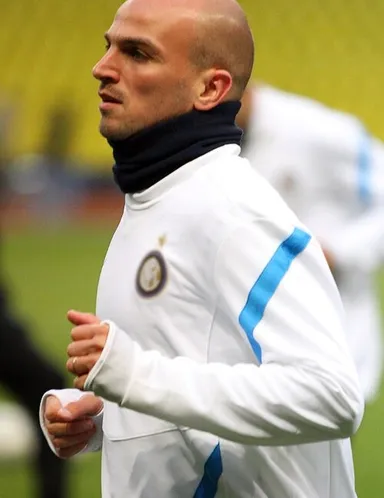 Photo: Майоров Владимир. Source and license in Image credits.
Esteban Matías Cambiasso Deleau
A thoughtful central midfielder whose positioning, left-foot connections and selective arrivals helped Inter become European champions.
Senior club · all competitions
Completed club records only; not a complete career total.
Active club snapshots and records with another scope are excluded. Assist totals are not combined across incompatible definitions.
Stored archive snapshots, not live counters. Missing values are not zero; records with different scopes are never added together.
G/M = goals ÷ appearances. G+A = goals + assists. Per-90 metrics use documented minutes.
Senior international · all competitions
Argentina · senior record, 2000–2011
Stored archive snapshots, not live counters. Missing values are not zero; records with different scopes are never added together.
G/M = goals ÷ appearances. G+A = goals + assists. Per-90 metrics use documented minutes.
In context
Cambiasso made collective organisation tangible: a passing angle, a protected lane and the judgment to join the attack at the right moment.
Reading the game
Esteban Cambiasso matters because he made the space around other players more usable. A midfielder can influence a match by carrying the ball through a line; Cambiasso often did it by standing where a teammate could pass safely, or where an opponent could no longer receive freely. At Inter, that relationship between positioning and collective freedom helped sustain a decade containing fifteen trophies. The 2009/10 treble provides the clearest reference: his central protection allowed the team to defend compactly without abandoning the possibility of a connected counterattack. Yet describing him only as a shield misses an important part of the player. Argentina’s flowing goal against Serbia and Montenegro in 2006 ended with his forward movement and left-foot finish, while his winner against Chelsea in 2010 came from recognising a second shooting opportunity. Those actions were different expressions of the same judgment: read what the move needs, then choose whether to hold, connect or arrive. This page treats that reading as editorial interpretation grounded in the documented matches, rather than a claim that every successful team action began with him.
Historical references support the chronology; tactical explanations are museum editorial analysis.
Historical references: Inter: Esteban Cambiasso, Hall of Fame ↗ · FIFA: Cambiasso and Argentina’s 2006 team goal ↗ · UEFA: 2009/10 Champions League technical report ↗ · UEFA: Cambiasso edges Inter in front against Chelsea ↗
Career
| Period | Club | Apps | Goals | G/M |
|---|---|---|---|---|
| 1996—1998 | Real Madrid BReserve-team league record: eight appearances in the 1996/97 second division and 34 in the 1997/98 third tier, with four goals in the latter. These are not Real Madrid first-team or La Liga appearances. Senior club · league only | 42 | 4 | 0.10 |
| 1998—2001 | IndependienteThree selected Argentine league seasons total 98 appearances and fourteen goals. Cup football is excluded. Senior club · league only | 98 | 14 | 0.14 |
| 2001—2002 | River PlateThe 2001/02 league record includes the 2002 Clausura championship. It excludes continental and domestic cup fixtures. Senior club · league only | 37 | 12 | 0.32 |
| 2002—2004 | Real MadridFirst-team La Liga record across two seasons, separate from the earlier reserve side. Madrid’s official biography records 67 competitive first-team appearances across all competitions. Senior club · league only | 41 | 0 | 0.00 |
| 2004—2014 | Inter MilanTen Serie A seasons total 315 appearances and 41 goals. The official all-competition aggregate is 430 appearances and 51 goals; its league subset is already included. Senior club · league only Senior · #19 | 315 | 41 | 0.13 |
| 2014—2015 | Leicester CityThe Premier League subset is 31 appearances and five goals. Leicester’s official account gives 33 appearances in all competitions; he left before the 2015/16 title season. Senior club · league only Senior · #19 | 31 | 5 | 0.16 |
| 2015—2017 | OlympiacosTwo Greek league seasons total 28 appearances and two goals. This selected league record excludes domestic cups and European matches. Senior club · league only Senior · #19 | 28 | 2 | 0.07 |
Stored archive snapshots, not live counters. Missing values are not zero; records with different scopes are never added together.
G/M = goals ÷ appearances. G+A = goals + assists. Per-90 metrics use documented minutes.
Honours
River Plate · league
Real Madrid · league
Real Madrid · domestic cup
Real Madrid · continental
Real Madrid · world
Inter Milan · league
Inter Milan · domestic cup
Inter Milan · domestic cup
Inter Milan · continental
Inter Milan · world
Olympiacos · league
Esteban Cambiasso · individual
Esteban Cambiasso · individual
Story
Career chapter
Cambiasso’s route was less direct than a seamless rise through one first team. After youth development at Argentinos Juniors, he played league football for Real Madrid B before returning to Argentina with Independiente and River Plate. The selected records distinguish those reserve appearances from his later Madrid first-team career. River’s 2002 Clausura title preceded the move back to Spain, where he contributed during the 2002/03 league-winning season. These chapters help explain the range of his eventual role: he had experience of building possession, joining attacks and competing for space around more celebrated creators before becoming Inter’s central reference.
Historical references: National Football Teams: Cambiasso’s seasons and Argentina appearances ↗ · Real Madrid: Esteban Matías Cambiasso Deleau ↗ · Leicester City in 100 players: Esteban Cambiasso ↗
Career chapter
Joining Inter in 2004 gave Cambiasso a sustained platform under Roberto Mancini. His value lay in connecting the defensive and attacking units without demanding that every possession revolve around him. The 2006 Coppa Italia final supplied a vivid counterpoint to the idea of a purely conservative midfielder: he volleyed in Javier Zanetti’s cross as Inter beat Roma in the second leg. A month later, his finish against Serbia and Montenegro brought Argentina’s extended passing sequence to its conclusion. Both moments illustrate an attacking instinct governed by timing. He could advance into a decisive position while remaining a player whose usual responsibility was to preserve the team’s connections.
Historical references: Inter: Cambiasso’s competitive archive ↗ · FIFA: Cambiasso and Argentina’s 2006 team goal ↗ · UEFA: Cambiasso’s volley in the 2006 Coppa Italia final ↗
Career chapter
Under José Mourinho, Cambiasso’s responsibilities became especially clear in Inter’s 2009/10 European campaign. UEFA’s technical analysis identifies the central screen as a foundation of the side’s organisation. Working within that structure meant judging when to follow a receiver, when to protect the space behind a teammate and when to keep the next pass available. It did not exclude decisive attacking interventions: his second attempt from outside the box secured the first-leg lead against Chelsea. The final against Bayern then placed his midfield work inside a collective performance completed by Diego Milito’s two goals. The reference season is therefore about complementary tasks, not assigning the entire treble to one player.
Historical references: UEFA: 2009/10 Champions League technical report ↗ · UEFA: technical report examines midfield protection ↗ · UEFA: Cambiasso edges Inter in front against Chelsea ↗ · UEFA: Inter win the 2010 Champions League final ↗
Career chapter
Cambiasso stayed at Inter until 2014, through a period of changing coaches and a team moving beyond its treble peak. Leicester then offered a markedly different challenge. He scored on his first Premier League start in the 5–3 comeback against Manchester United and became an experienced reference during the eventual escape from relegation. The supporters’ season award recognised that contribution, rather than a title won after his departure. His final playing chapter brought two league championships with Olympiacos before retirement in 2017. This late career is best read as adaptation: preserving useful anticipation, distribution and communication while operating in new teams and at a different physical stage.
Historical references: Leicester City in 100 players: Esteban Cambiasso ↗ · Leicester: Cambiasso thanks the supporters ↗ · Olympiacos: Cambiasso joins in August 2015 ↗ · Olympiacos: Cambiasso’s contract extension ↗
Profile
Holding Midfielder
Also plays · Box-to-Box Midfielder
The 2009/10 reference centres on Inter’s compact midfield screen. Cambiasso protects central routes, offers the next connection after a regain and advances selectively. The assessment values anticipation and decisions above pace or individual dribbling. Both panels use this same season.
Reading central passing lanes
Support angles after regains
Selective attacking arrivals
Collective positional discipline
Illustrative role zones · not tracking data
Cambiasso’s defensive identity begins with the route the opponent wants to use. In Inter’s compact structure, staying connected to the centre-backs and the other midfielder could matter more than chasing the ball immediately. The editorial reading is that his anticipation reduced the need for emergency recovery. This should not be confused with passive defending: stepping across a passing lane or closing a receiver as the pass travelled was an active intervention, supported by the positions of the teammates around him.
His left foot gave the team a reliable connection after a regain, but the first contribution could happen before he received. By offering an angle behind pressure, he helped a teammate avoid playing into a closed route. The important distinction is between keeping circulation useful and controlling every phase as a specialist regista. Cambiasso could switch or advance the ball, yet Inter’s creativity was distributed across players such as Sneijder. His contribution often made their next action available instead of replacing it.
The forward run was selective rather than constant. Argentina’s 2006 World Cup goal shows him participating in the connection and then arriving to finish after Hernán Crespo’s return. Against Chelsea in 2010, the decisive action came from staying available outside the box and responding to a blocked attempt. These are different routes to scoring, linked by patience and recognition of the next space. They support strong anticipation and decision-making grades without turning him into a prolific attacking midfielder or an explosive dribbler.
The system still mattered. Cambiasso benefited from compact distances, disciplined partners and defenders able to manage the space behind him. His reading of play did not guarantee success in open-field races, aerial duels or isolated dribbling contests. The assessment therefore separates excellent positional defence from merely solid athletic tools. Leicester’s later season adds evidence of adaptability and experience, but its achievements are kept distinct from the 2009/10 version used for both rating panels.
Historical references: Inter: Cambiasso’s intelligence and ten seasons ↗ · Leicester City in 100 players: Esteban Cambiasso ↗ · FIFA: Cambiasso and Argentina’s 2006 team goal ↗ · UEFA: 2009/10 Champions League technical report ↗ · UEFA: technical report examines midfield protection ↗ · UEFA: Cambiasso edges Inter in front against Chelsea ↗
Reading the game
| Era / team | Primary Role | Tactical Character |
|---|---|---|
| 1996–2004Real Madrid B / Independiente / River Plate / Real Madrid | Learning both directions | Reserve and first-team environments developed his ability to support possession and arrive further forward. |
| 2004–2008Inter Milan | The reliable central connection | Mancini’s Inter gained a midfielder who balanced central responsibility with selective attacking movement. |
| 2008–2010Inter Milan | Protection within a flexible structure | Mourinho’s team used compact central distances, with Cambiasso helping protect and connect the next action. |
| 2010–2014Inter Milan | Continuity through changing teams | His Inter responsibilities continued across coaching changes after the treble. |
| 2014–2017Leicester City / Olympiacos | Experience in new settings | Leicester’s survival and Olympiacos league titles required adapting his reading and distribution to different teams. |
Historical references: Inter: Cambiasso’s competitive archive ↗ · National Football Teams: Cambiasso’s seasons and Argentina appearances ↗ · Real Madrid: Esteban Matías Cambiasso Deleau ↗ · Leicester City in 100 players: Esteban Cambiasso ↗ · Olympiacos: Cambiasso’s contract extension ↗ · UEFA: 2009/10 Champions League technical report ↗ · UEFA: Cambiasso’s volley in the 2006 Coppa Italia final ↗
Reading the game
The most useful defensive action could be the adjustment that discouraged a pass. Cambiasso’s central position helped Inter protect the route into the forwards while remaining close enough to contest a loose ball. This trait is assessed through the team’s documented structure; it is not an invented count of interceptions or an assertion that he never needed recovery tackles.
Winning space defensively was only half the task. Cambiasso also offered a manageable next pass, allowing a regain to become possession rather than another immediate clearance. His relationship with the other midfielders matters here: support angles and shared distances are more revealing than a picture of one isolated holding player doing every job alone.
The left-foot volley against Roma in 2006 and the second strike against Chelsea in 2010 reveal more than occasional luck near goal. They show a midfielder prepared to complete a move when its shape invited him forward. The editorial emphasis is on readiness and timing, while the relatively modest scoring totals keep the attacking assessment in proportion.
Leicester’s 2014/15 season placed Cambiasso in a different competitive problem from Inter’s title campaigns. His contribution to survival and the club’s season award show that his value could transfer beyond a familiar system. That evidence supports adaptability, without implying that a veteran version had the same physical capacity or tactical surroundings as his Inter peak.
Historical references: Leicester City in 100 players: Esteban Cambiasso ↗ · Leicester: historical Player of the Season awards ↗ · UEFA: 2009/10 Champions League technical report ↗ · UEFA: technical report examines midfield protection ↗ · UEFA: Cambiasso edges Inter in front against Chelsea ↗ · UEFA: Cambiasso’s volley in the 2006 Coppa Italia final ↗
Reading the game
Holding midfielder with selective forward runs
The Inter and Argentina version combines developing authority in midfield with visible attacking arrivals. The Coppa Italia volley and World Cup team goal are useful entry points, but they should be read alongside his connecting work rather than as proof that scoring was his main job.
Holding midfielder in a compact central screen
The common reference for both evaluations. Central protection, short connections and well-judged attacking support work together inside Mourinho’s adaptable structure. The Chelsea winner makes the attacking contribution visible; the technical report explains the less spectacular platform that kept the team connected.
Experienced central midfielder
A representative late-career version, rather than a claim that Leicester surpassed his Inter peak. He helped a new team navigate a difficult league season and earned its Player of the Season award. The emphasis shifts toward reading, distribution and communication within the demands of a relegation struggle.
Historical references: Leicester City in 100 players: Esteban Cambiasso ↗ · Leicester: historical Player of the Season awards ↗ · FIFA: Cambiasso and Argentina’s 2006 team goal ↗ · UEFA: 2009/10 Champions League technical report ↗ · UEFA: Cambiasso edges Inter in front against Chelsea ↗ · UEFA: Cambiasso’s volley in the 2006 Coppa Italia final ↗
Statistics
| Season | Club | Apps | Goals | G/M |
|---|---|---|---|---|
| 2016/17 | Olympiacos Senior club · league only | 14 | 0 | 0.00 |
| 2015/16 | Olympiacos Senior club · league only | 14 | 2 | 0.14 |
| 2014/15 | Leicester City Senior club · league only | 31 | 5 | 0.16 |
| 2013/14 | Inter Milan Senior club · league only | 32 | 4 | 0.13 |
| 2012/13 | Inter Milan Senior club · league only | 33 | 3 | 0.09 |
| 2011/12 | Inter Milan Senior club · league only | 37 | 4 | 0.11 |
| 2010/11 | Inter Milan Senior club · league only | 30 | 7 | 0.23 |
| 2009/10 | Inter Milan Senior club · league only | 30 | 3 | 0.10 |
| 2008/09 | Inter Milan Senior club · league only | 35 | 4 | 0.11 |
| 2007/08 | Inter Milan Senior club · league only | 33 | 6 | 0.18 |
Stored archive snapshots, not live counters. Missing values are not zero; records with different scopes are never added together.
G/M = goals ÷ appearances. G+A = goals + assists. Per-90 metrics use documented minutes.
Twenty-one selected league rows total 592 appearances and 78 goals, including 42 appearances and four goals for Real Madrid B. The remaining first-team league subset is 550/74. The B team played in the second tier in 1996/97 and the third tier in 1997/98; those rows are not La Liga. Youth development at Argentinos Juniors is not entered as first-team appearances. Club all-competition aggregates already include their league subsets and must not be added to these rows. Unknown assists remain null.
Club competitions
| Competition | Apps | Goals | G/M |
|---|---|---|---|
Serie ASerie A · Inter, 2004–2014Ten league seasons; domestic cups and international club competitions are excluded. | 315 | 41 | 0.13 |
La LigaLa Liga · Real Madrid first team, 2002–2004Twenty-four and seventeen league appearances in successive seasons. Earlier Real Madrid B matches belong to lower divisions. | 41 | 0 | 0.00 |
Premier LeaguePremier League · Leicester, 2014/15League subset of the club’s 33 competitive appearances; no 2015/16 appearances are implied. | 31 | 5 | 0.16 |
UEFA Champions LeagueChampions League · 2009/10 reference season onlyUEFA’s technical report records twelve appearances and the Chelsea goal. This is one season, not a career Champions League total. | 12 | 1 | 0.08 |
Stored archive snapshots, not live counters. Missing values are not zero; records with different scopes are never added together.
G/M = goals ÷ appearances. G+A = goals + assists. Per-90 metrics use documented minutes.
International
International career
Fifty-two senior appearances and five goals, including the finish to Argentina’s celebrated passing move against Serbia and Montenegro at the 2006 World Cup. Youth honours are separate from this senior record.
Senior international · tournament splits
| Competition | Apps | Goals | G/M |
|---|---|---|---|
FIFA World CupWorld Cup finals · 2006Five tournament appearances and one goal. Qualification, youth tournaments and shoot-out penalties are excluded. | 5 | 1 | 0.20 |
Copa AméricaCopa América · 2007 and 2011Six appearances in 2007 and two in 2011; senior finals tournaments only. | 8 | 0 | 0.00 |
Stored archive snapshots, not live counters. Missing values are not zero; records with different scopes are never added together.
G/M = goals ÷ appearances. G+A = goals + assists. Per-90 metrics use documented minutes.
Reading the game
Cambiasso’s legacy is a reminder that tactical intelligence is visible in relationships, not only in spectacular individual interventions. Inter remember a player who combined responsibility with invention: 430 competitive appearances, 51 goals and a place in the club’s 2020 Hall of Fame. His importance cannot be reduced to those totals, but neither should the language of selflessness erase his attacking contribution. A well-timed arrival was part of his midfield craft, not a departure from it. His career also travelled beyond the environment in which he became most recognisable. Development in Argentina and Real Madrid’s reserve side preceded a first-team Madrid spell; a single Leicester season later showed how an experienced organiser could contribute to a team fighting relegation. That 2014/15 contribution earned the club’s Player of the Season award, before he moved to Olympiacos and won two Greek league titles. He did not belong to Leicester’s subsequent championship squad. For Argentina, 52 senior appearances and five goals include an unforgettable World Cup team move, but no senior international trophy. The resulting portrait is substantial without being inflated: a distinguished club midfielder whose best work made difficult collective decisions easier for the players around him.
Historical references: Inter: the 2020 Hall of Fame inductees ↗ · National Football Teams: Cambiasso’s seasons and Argentina appearances ↗ · Leicester City in 100 players: Esteban Cambiasso ↗ · Leicester: historical Player of the Season awards ↗
Archive
Holding Midfielder · editorial peak 2009—2010
Vicente del Bosque · Carlos Queiroz · Roberto Mancini · José Mourinho · Rafael Benítez · Claudio Ranieri · Andrea Stramaccioni · Walter Mazzarri · Nigel Pearson · Marco Silva
Ronaldo Nazário— Overlapping Real Madrid era · Zinedine Zidane— Overlapping Real Madrid era · Luís Figo— Overlapping Real Madrid era · Iker Casillas— Overlapping Real Madrid era
Galácticos — Real Madrid · The treble — Inter Milan

Cruzeiro · PSV · Barcelona
1993—2011
AS Cannes · Bordeaux · Juventus
1989—2006 Photo: Žan Kolman. Source and license in Image credits.
Sporting CP · Barcelona · Real Madrid
1989—2009
FC Barcelona · Paris Saint-Germain · Inter Miami CF
2004—Present Photo: Unknown author. Source and license in Image credits.
Argentinos Juniors · Boca Juniors · Barcelona
1976—1997 Photo: Unknown author. Source and license in Image credits.
River Plate · Huracán · Millonarios
1945—1966Statistics are displayed only within the scope supported by each cited source.
Inter MilanInter: Esteban Cambiasso, Hall of FameInter MilanInter: Cambiasso’s competitive archiveInter MilanInter: the 2020 Hall of Fame inducteesInter MilanInter: Cambiasso’s intelligence and ten seasonsNational Football TeamsNational Football Teams: Cambiasso’s seasons and Argentina appearancesReal MadridReal Madrid: Esteban Matías Cambiasso DeleauLeicester CityLeicester City in 100 players: Esteban CambiassoLeicester CityLeicester: Cambiasso thanks the supportersLeicester CityLeicester: historical Player of the Season awardsOlympiacosOlympiacos: Cambiasso joins in August 2015OlympiacosOlympiacos: Cambiasso’s contract extensionFIFAFIFA: Cambiasso and Argentina’s 2006 team goalUEFAUEFA: 2009/10 Champions League technical reportUEFAUEFA: technical report examines midfield protectionUEFAUEFA: Cambiasso edges Inter in front against ChelseaUEFAUEFA: Inter win the 2010 Champions League finalUEFAUEFA: Cambiasso’s volley in the 2006 Coppa Italia finalBDFutbolBDFutbol: Cambiasso’s Spanish league record