From a secure reception to a new opening
- Receiving orientation
- Generational
- Short-distance pressure escape
- Generational
- Drawing and releasing
- Elite
- Combination timing
- Generational
- Collective defensive support
- Good
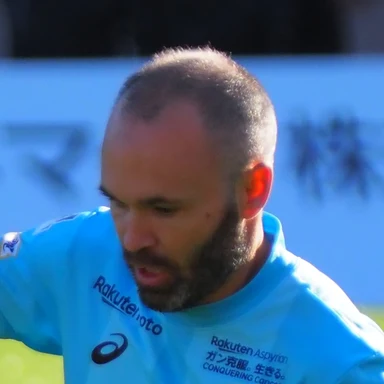 Photo: Tam Tam. Source and license in Image credits.
Andrés Iniesta Luján
A creative midfielder who turned close control, body orientation and short combinations into openings for Barcelona and Spain.
Senior club · all competitions
Completed club records only; not a complete career total.
Active club snapshots and records with another scope are excluded. Assist totals are not combined across incompatible definitions.
Stored archive snapshots, not live counters. Missing values are not zero; records with different scopes are never added together.
G/M = goals ÷ appearances. G+A = goals + assists. Per-90 metrics use documented minutes.
Senior international · all competitions
Stored archive snapshots, not live counters. Missing values are not zero; records with different scopes are never added together.
G/M = goals ÷ appearances. G+A = goals + assists. Per-90 metrics use documented minutes.
In context
Iniesta gave possession a change of direction and pace. His pressure escapes, combinations and timely arrivals explain a legacy that reaches beyond the famous goals in London and Johannesburg.
Reading the game
Iniesta explains how possession can become penetration without a dramatic change in the team’s shape. He could receive inside a crowded midfield, move the ball just beyond a challenge and find a teammate before the next defender had settled. The important action was often smaller than a spectacular dribble: a body turn, a short diagonal carry or a pass that allowed someone else to accelerate. His control created options, and his judgment decided which option kept the advantage alive.
That made him a distinctive partner for Xavi, Busquets and Messi at Barcelona, and a different kind of wide attacker for Spain. He could move inside from the left without simply abandoning width, because teammates adjusted around the space he left. The 2012 European Championship is especially revealing: UEFA named him the tournament’s best player despite a record of no goals and one assist. The famous finishes at Chelsea and in Johannesburg matter, but they are only part of the story. Understanding Iniesta also means noticing the reception that escapes pressure and the pass before the final pass, when the defence first loses its balance.
Historical references support the chronology; tactical explanations are museum editorial analysis.
Historical references: UEFA: Iniesta named EURO 2012’s best player ↗ · UEFA: Spain’s 4–0 victory in the 2012 final ↗ · UEFA: Iniesta’s assist in Barcelona’s 2015 European final ↗ · FIFA: Iniesta’s World Cup winner and tribute to Dani Jarque ↗
Career
| Period | Club |
|---|---|
| 2002—2018 | FC BarcelonaBarcelona’s first-team retrospective records 674 appearances and 57 goals. Its players archive lists 680 official appearances with the same goals; the difference is unreconciled. The first-team retrospective is preferred here. Assists remain unverified. Senior club · all competitions Performance record
|
| 2018—2023 | Vissel KobeKobe’s May 2023 departure announcement contains an interim statistical snapshot before his final match. It is not presented as a complete 2018–2023 club total; missing values are not zero. |
| 2023—2024 | Emirates ClubFinal playing chapter at Emirates Club, 2023–2024, before retirement in October 2024. Complete competitive appearances, goals and assists remain unverified here. |
Stored archive snapshots, not live counters. Missing values are not zero; records with different scopes are never added together.
G/M = goals ÷ appearances. G+A = goals + assists. Per-90 metrics use documented minutes.
Honours
FC Barcelona · continental
Spain · world
Spain · continental
Vissel Kobe · domestic cup
Vissel Kobe · domestic cup
UEFA · individual
FC Barcelona · league
FC Barcelona · domestic cup
FC Barcelona · domestic cup
FC Barcelona · continental
FC Barcelona · world
Spain · individual
Story
Club chapter
The academy route did not immediately give Iniesta one permanent first-team position. His early Barcelona years involved learning to receive and combine in several midfield settings, with the left interior role gradually becoming a natural home. The 2006 Champions League final illustrates the value of that versatility: he entered at half-time and helped the team’s play after the break. The broader development was the ability to remain useful before a clear opening existed. He could offer a short passing angle, protect the next touch and move again, building the habits that later allowed him to play inside stronger and more established collective structures.
Historical references: Barcelona Legends: Iniesta’s career and 2024 retirement ↗ · UEFA: Iniesta remembers four Champions League wins ↗ · Andrés Iniesta — biographical and career reference ↗
Explore club contextCareer chapter
The Chelsea goal in 2009 and the World Cup final winner in 2010 solved different attacking problems. At Stamford Bridge, Iniesta struck from outside the box to make the second leg 1–1 and send Barcelona through on the away-goals rule then in force. In Johannesburg, he arrived in a right-sided position and finished Fàbregas’s pass in extra time. Neither moment makes him a volume scorer. Together they show a midfielder willing to finish when the situation demanded it, whether the opening appeared beyond a defensive block or through a run into the area after a long match of resistance.
Historical references: FIFA: Iniesta’s World Cup winner and tribute to Dani Jarque ↗ · UEFA: Iniesta’s late equaliser sends Barcelona through in 2009 ↗ · Andrés Iniesta — biographical and career reference ↗
Club chapter
Barcelona and Spain made different use of Iniesta’s ability to move through crowded areas. As an interior, he could connect midfield possession with Messi and the players ahead; from Spain’s left, he could move inside while a full-back supplied the outside lane. The opening goal in the 2012 European final began with his pass releasing Fàbregas before Silva’s finish. In the 2015 Champions League final, he instead supplied the final touch into Rakitić’s path. These examples distinguish creation from the last pass. His later Barcelona years continued that connecting work with new attacking partners before his farewell in 2018.
Historical references: Barcelona: Iniesta’s 674 appearances and 57 goals ↗ · UEFA: Spain’s 4–0 victory in the 2012 final ↗ · UEFA: Iniesta’s assist in Barcelona’s 2015 European final ↗ · Andrés Iniesta — biographical and career reference ↗
Explore club contextCareer chapter
The move to Vissel Kobe in 2018 placed familiar receiving and passing skills in a different football environment. His Japanese chapter included the Emperor’s Cup and the Japanese Super Cup, before his departure during 2023. Those achievements should be tied to their actual competitions and dates, rather than treating his exit as the end of an entire Japanese season. Emirates Club then provided the last club chapter before his retirement in October 2024. The later career is useful as a study of which qualities travel: awareness, the timing of combinations and the ability to help a teammate continue, even when the surrounding structure changes.
Historical references: Barcelona Legends: Iniesta’s career and 2024 retirement ↗ · RFEF: Iniesta’s senior goals, assists and international legacy ↗ · Vissel Kobe: Iniesta’s departure announcement and career record ↗ · Andrés Iniesta — biographical and career reference ↗
Profile
Advanced Playmaker
Also plays · Left Interior
Receives with an open body, turns away from pressure and draws the next defender with a short carry. Quick combinations connect midfield and attack, with the surrounding players supplying width and cover.
Press resistance
Ball control
Short combinations
Spatial awareness
Illustrative role zones · not tracking data
Iniesta’s close control matters because the next action remains available after the ball arrives. A small change in body angle can move a challenge away from the intended route. He can then turn, return the ball or carry across the opponent’s line. The aim is not always an immediate breakthrough; sometimes it is to preserve enough time for a teammate to create the next passing angle.
A short diagonal carry can be more useful than a long sprint if it forces the next defender to step out. Iniesta could move from the left towards a central lane and release the ball when a teammate became accessible. The gain belonged to the team, not just the player who escaped. Carrying for an extra touch could close the opening again, making timing central to the technique.
He can give the ball away briefly without leaving the attack. Moving after a short pass changes the relationship between the marker, the receiver and the return route. With Barcelona, the proximity of other technically secure players made those exchanges repeatable. That collective quality matters: a successful escape often depends on the teammate who supplies the wall or occupies the defender Iniesta will face next.
Spain could place Iniesta towards the left without asking him to behave as a touchline dribbler on every possession. Moving inside created another connection around the midfield, while the outside lane could be used by an advancing full-back. This changed who supplied width rather than removing width from the attack. The arrangement required awareness of nearby positions and a shared response when possession was lost.
His defensive contribution began partly with the quality of the attack: a controlled pass and a supporting position reduced the distance between teammates. When possession changed, those distances could help an immediate attempt to recover it. This did not make him a specialist holding midfielder. Central screening, aerial duels and covering an exposed back line required other responsibilities to remain properly distributed around his creative movement.
Historical references: UEFA: Iniesta named EURO 2012’s best player ↗ · UEFA: Spain’s 4–0 victory in the 2012 final ↗ · UEFA: Iniesta’s assist in Barcelona’s 2015 European final ↗ · UEFA: Iniesta remembers four Champions League wins ↗
Reading the game
| Era / team | Primary Role | Tactical Character |
|---|---|---|
| 2002–2008Barcelona | Learning through midfield versatility | Develops receiving and combination play across several midfield starting positions. |
| 2008–2012Barcelona | The left interior inside the passing structure | Combines with nearby midfielders and changes the route with a diagonal carry. |
| 2008–2012Spain | Moving inside from Spain’s left | Connects the central players while a teammate supplies width; this is a selected peak phase. |
| 2012–2018Barcelona | Connecting changing Barcelona attacks | Keeps carrying and combination useful around different forward partnerships. |
| 2018–2023Vissel Kobe | Applying the craft in Japan | Brings receiving angles and combination timing into a different club environment. |
| 2023–2024Emirates Club | The final club chapter | Concludes his playing career in a new setting before retirement in October 2024. |
Historical references: Barcelona: Iniesta’s 674 appearances and 57 goals ↗ · Barcelona Legends: Iniesta’s career and 2024 retirement ↗ · RFEF: Iniesta’s senior goals, assists and international legacy ↗ · UEFA: Spain’s 4–0 victory in the 2012 final ↗ · UEFA: Iniesta’s assist in Barcelona’s 2015 European final ↗ · UEFA: Iniesta remembers four Champions League wins ↗ · FIFA: Iniesta’s World Cup winner and tribute to Dani Jarque ↗ · UEFA: Iniesta’s late equaliser sends Barcelona through in 2009 ↗ · Vissel Kobe: Iniesta’s departure announcement and career record ↗
Reading the game
Spain’s opening goal in the 2012 final is a clear illustration of value that an assist count cannot fully capture. Iniesta released Fàbregas, whose next delivery allowed Silva to score. The decisive movement of the defence had already begun before the final ball. Understanding that sequence prevents the last touch in a move from absorbing all the credit for its creation.
A defender approaching at speed wants a predictable next touch. Iniesta could shorten that touch, alter the angle and keep the ball close enough to choose again. This made a small pocket of space usable rather than simply safe. The subtlety matters because the move might advance only a few metres while removing an entire line of pressure from the next pass.
Iniesta could help prepare an attack and then arrive where another teammate could find him. In Berlin in 2015, he became the receiver before supplying Rakitić; in the World Cup final, he became the finisher. Those changes are a useful expression of his intelligence: the team’s need, rather than a fixed personal role, determined the next action.
The Chelsea and Netherlands finishes are exceptional landmarks within a career built largely on other actions. They show that a creative midfielder can accept the finishing responsibility when the opening demands it. The 2012 tournament offers the complementary evidence: influence can be sustained without a goal, through the repeated quality of receiving, movement and decisions that make the attack work.
Historical references: UEFA: Iniesta named EURO 2012’s best player ↗ · UEFA: Spain’s 4–0 victory in the 2012 final ↗ · UEFA: Iniesta’s assist in Barcelona’s 2015 European final ↗ · UEFA: Iniesta remembers four Champions League wins ↗ · FIFA: Iniesta’s World Cup winner and tribute to Dani Jarque ↗ · UEFA: Iniesta’s late equaliser sends Barcelona through in 2009 ↗
Reading the game
Penetrating left interior
The 2009–2011 Barcelona version joined close control with diagonal movement from midfield towards the attack. He could combine within the passing structure or leave it briefly with a carry that forced an opponent to react. The Chelsea equaliser is the famous endpoint, but the broader peak was the repeated ability to turn a secure reception into an opening for the team.
Left-sided roaming creator
At EURO 2012, Iniesta’s starting position and movement gave Spain another route between midfield and the forward line. His involvement in the opening goal of the final is a better guide than the scoring column alone. The tournament’s best-player award reflected a contribution built on incisive movement and creation, with teammates supplying the outside runs and finishing actions.
Connecting interior
The 2014/15 team placed Iniesta behind Messi, Suárez and Neymar in a different attacking arrangement from the earlier peak. His job still included carrying through pressure and connecting the next receiver, but the forward line offered new combinations and destinations. The Berlin assist shows an experienced midfielder arriving in the right space, then making the chance easier for Rakitić rather than insisting on the finish himself.
Historical references: UEFA: Iniesta named EURO 2012’s best player ↗ · UEFA: Spain’s 4–0 victory in the 2012 final ↗ · UEFA: Iniesta’s assist in Barcelona’s 2015 European final ↗ · UEFA: Iniesta remembers four Champions League wins ↗ · UEFA: Iniesta’s late equaliser sends Barcelona through in 2009 ↗
Statistics
Club competitions
| Competition | Apps | Goals | G/M |
|---|---|---|---|
UEFA Champions League2002–2018Barcelona only · Champions League career, 2002–2018. Excludes league and other cup matches. | 132 | 11 | 0.08 |
Stored archive snapshots, not live counters. Missing values are not zero; records with different scopes are never added together.
G/M = goals ÷ appearances. G+A = goals + assists. Per-90 metrics use documented minutes.
International
International career
Spain senior career, 2006–2018: RFEF records 131 appearances, 13 goals and 29 assists. The 2008 and 2012 European titles and 2010 World Cup belong to the senior team; youth honours are excluded. EURO 2012 statistics are shown separately from career totals.
Senior international · tournament splits
| Competition | Apps | Goals | Assists | G/M | G+A/M |
|---|---|---|---|---|---|
UEFA European Championship2012Spain only · EURO 2012 finals, six matches. Zero goals is verified; this is not a senior career total. Performance record
| 6 | 0 | 1 | 0.00 | 0.17 |
Stored archive snapshots, not live counters. Missing values are not zero; records with different scopes are never added together.
G/M = goals ÷ appearances. G+A = goals + assists. Per-90 metrics use documented minutes.
Reading the game
Iniesta’s lasting contribution is a model of creative midfield play in which technical quality changes the next situation rather than merely preserving the ball. His turns and carries could make an opponent step out; his combinations could then use the space that movement exposed. The result was a form of progression that fitted collective possession football without making the individual passive. He belonged within Barcelona’s structure, but he also supplied the interruption of rhythm that made the structure difficult to defend. The same intelligence worked from different starting positions with Spain, where moving in from the left could connect the midfield and the attack.
His decisive goals provide enduring images, but treating them as his entire legacy would misread a player whose greatest tournament recognition came without scoring. The World Cup final rewarded a late attacking arrival; the 2012 European title highlighted movement, invention and continuity across a competition. Four Champions League wins likewise involved different teammates and responsibilities, rather than one unchanged team. His Japanese and Emirati chapters belong to the record before his retirement in 2024, without requiring later seasons to reproduce every physical quality of his peak. The enduring lesson is that a midfielder can transform a match through the quality of the next touch, while still relying on runners, supporting angles and a coordinated response when the ball is lost.
Historical references: Barcelona Legends: Iniesta’s career and 2024 retirement ↗ · UEFA: Iniesta named EURO 2012’s best player ↗ · UEFA: Iniesta remembers four Champions League wins ↗ · FIFA: Iniesta’s World Cup winner and tribute to Dani Jarque ↗ · Vissel Kobe: Iniesta’s departure announcement and career record ↗
Archive
Advanced Playmaker · editorial peak 2008—2015
Thierry Henry— Overlapping FC Barcelona era · Carles Puyol— Overlapping FC Barcelona era · Xavi— Overlapping FC Barcelona era · Lionel Messi— Overlapping FC Barcelona era
Ronaldo, Figo and the centenary — FC Barcelona · Ronaldinho and renewal — FC Barcelona · Guardiola’s positional game — FC Barcelona · A second treble — FC Barcelona

Positional football architect
2007—2026 · Barcelona · Bayern Munich Photo: Илья Хохлов / Football.ua. Source and license in Image credits.
Continuity and technical control
1987—2016 · Real Madrid
Barcelona · Al Sadd
1998—2019
FC Barcelona · Paris Saint-Germain · Inter Miami CF
2004—Present Photo: Marcos Corrêa/PR. Source and license in Image credits.
Grêmio · Paris Saint-Germain · FC Barcelona
1998—2018
Barcelona
1999—2014Barcelona · Al Sadd
1998—2019 Photo: Real Madrid. Source and license in Image credits.
Sevilla · Real Madrid · Paris Saint-Germain
2004—Present
AS Cannes · Bordeaux · Juventus
1989—2006
Manchester United · Preston North End · Waterford
1956—1976 Photo: Klearchos Kapoutsis. Source and license in Image credits.
Nancy · Saint-Étienne · Juventus
1972—1987Statistics are displayed only within the scope supported by each cited source.
FC BarcelonaBarcelona: Iniesta’s 674 appearances and 57 goalsFC BarcelonaBarcelona Players: Iniesta’s archival statisticsFC BarcelonaBarcelona: Iniesta’s 32 club titlesFC BarcelonaBarcelona Legends: Iniesta’s career and 2024 retirementRFEFRFEF: Iniesta’s 131 senior appearancesRFEFRFEF: Iniesta’s senior goals, assists and international legacyUEFAUEFA: Iniesta named EURO 2012’s best playerUEFAUEFA: Spain’s 4–0 victory in the 2012 finalUEFAUEFA: Iniesta’s assist in Barcelona’s 2015 European finalUEFAUEFA: Iniesta remembers four Champions League winsFIFAFIFA: Iniesta’s World Cup winner and tribute to Dani JarqueUEFAUEFA: Iniesta’s late equaliser sends Barcelona through in 2009Vissel KobeVissel Kobe: Iniesta’s departure announcement and career recordFC BarcelonaIniesta announces retirement, October 2024Wikipedia (cited biographical reference)Andrés Iniesta — biographical and career reference