

The football behind David Trezeguet’s ratings
- Penalty-area anticipation
- Generational
- First-time finishing
- Generational
- Directed attacking headers
- Elite
- Complementary forward movement
- Elite
- Short combinations
- Good
- Defensive pressing
- Limited
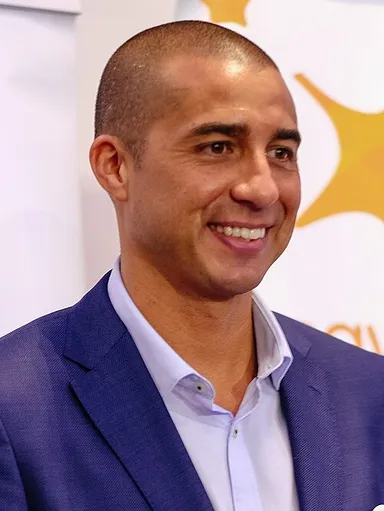 Photo: Save the Dream from Doha, Qatar. Source and license in Image credits.
David Sergio Trezeguet
A specialist centre-forward whose anticipation, heading and first-time finishing gave creative teammates a precise target near goal.
Senior club · all competitions
Completed club records only; not a complete career total.
Active club snapshots and records with another scope are excluded. Assist totals are not combined across incompatible definitions.
Stored archive snapshots, not live counters. Missing values are not zero; records with different scopes are never added together.
G/M = goals ÷ appearances. G+A = goals + assists. Per-90 metrics use documented minutes.
Senior international · all competitions
France · FFF senior record, 1998–2008
Stored archive snapshots, not live counters. Missing values are not zero; records with different scopes are never added together.
G/M = goals ÷ appearances. G+A = goals + assists. Per-90 metrics use documented minutes.
In context
His craft shows how a forward can shape an attack through the movement before the pass and the quality of the first contact.
Reading the game
David Trezeguet makes a particular kind of football intelligence visible: understanding where a chance will arrive before the ball gets there. His best work often began with a small adjustment beside a centre-back, followed by an immediate finish. Headers, volleys and close-range shots belonged to the same method. He reduced the time between receiving service and threatening the goal, making the work of creative teammates more valuable. At Monaco that talent emerged alongside a young Thierry Henry; at Juventus it found a durable relationship with Alessandro Del Piero’s movement and invention. The pairing offered different solutions within the same attack, with Trezeguet keeping defenders occupied near goal while others connected the play. France’s golden goal in the EURO 2000 final remains his most famous expression of that economy. Yet one finish cannot explain a decade in Turin or his later contribution to River Plate’s return to the top division. His career invites a closer look at the specialist striker: how anticipation, contact quality and partnership can produce influence without a large share of the ball.
Historical references support the chronology; tactical explanations are museum editorial analysis.
Historical references: Juventus Hall of Fame: David Trezeguet ↗ · Monaco: Trezeguet’s development, seasons and 125-match record ↗ · UEFA: the EURO 2000 final and its golden goal ↗ · River Plate: the return to the top division in 2012 ↗
Career
| Period | Club | Apps | Goals | G/M |
|---|---|---|---|---|
| 1994—1995 | PlatenseFive documented senior league appearances across 1993/94 and 1994/95. The career begins with his 1994 first-team debut, not the start year of the season label or his youth registration. Youth matches are excluded. Senior club · league only | 5 | 0 | 0.00 |
| 1995—2000 | AS MonacoMonaco’s official first-team record is 125 appearances and 62 goals. The league subset is 93/52, using the club’s thirty appearances in 1999/2000 rather than NFT’s twenty-nine. Reserve-team matches are excluded. Senior club · all competitions Senior · #9 | 125 | 62 | 0.50 |
| 2000—2010 | JuventusCompleted Juventus competitive record: 320 appearances and 171 goals. League seasons total 245/138, including the 2006/07 Serie B contribution of 31/15. Only the 2001/02 and 2002/03 Serie A titles are credited; removed titles are excluded. Senior club · all competitions Senior · #17 | 320 | 171 | 0.53 |
| 2010—2011 | HérculesOne La Liga season: 31 appearances and twelve goals. This is the league record, not a claim to a reconciled all-competition total. Historical assists remain unverified. Senior club · league only | 31 | 12 | 0.39 |
| 2011—2011 | BaniyasThree league appearances during the short 2011 spell, recorded within the 2011/12 season. Cup appearances are outside this row. The later River spell has its own record. Senior club · league only | 3 | 0 | 0.00 |
| 2011—2013 | River PlateJoined in December 2011 and played league matches in 2012 and 2013. The 35/16 total combines 19/13 in Primera B Nacional and 16/3 in the top flight; it is not an all-top-flight record. Senior club · league only | 35 | 16 | 0.46 |
| 2013—2014 | Newell’s Old BoysThe 2013/14 league record is 24 appearances and seven goals. Copa Libertadores and other cup matches are excluded from this league-only summary. Senior club · league only Loan | 24 | 7 | 0.29 |
| 2014—2014 | Pune CityNine appearances and two goals in the 2014 Indian Super League. His final playing season is 2014; the retirement announcement came in January 2015, so the overall career end year differs from the last match year. Senior club · league only | 9 | 2 | 0.22 |
Stored archive snapshots, not live counters. Missing values are not zero; records with different scopes are never added together.
G/M = goals ÷ appearances. G+A = goals + assists. Per-90 metrics use documented minutes.
Honours
AS Monaco · league
AS Monaco · domestic cup
Juventus · league
Juventus · domestic cup
Juventus · league
River Plate · league
France · world
France · continental
David Trezeguet · individual
David Trezeguet · individual
David Trezeguet · individual
Story
Career chapter
Born in Rouen and raised in Argentina, Trezeguet reached senior football with Platense before moving to Monaco in 1995. The first seasons required patience; the major breakthrough came in 1997/98, when he scored eighteen league goals and struck at Old Trafford to help eliminate Manchester United on away goals. That shot from the edge of the area also complicates the image of a forward restricted to tap-ins. The more repeatable strength was his ability to find scoring positions inside a developing team. Monaco won another French title in 1999/2000, with his twenty-two league goals providing a foundation for the move to Juventus.
Historical references: Monaco: Trezeguet’s development, seasons and 125-match record ↗ · Monaco: Trezeguet’s 1998 strike at Old Trafford ↗ · Trezeguet: league seasons and the 70-cap classification ↗
Career chapter
The EURO 2000 final showed how a substitute could decide a match without reshaping the whole attack. Trezeguet met Robert Pirès’s delivery with a left-foot finish that ended the contest under the golden-goal rule. At Juventus, his responsibility grew across a longer sequence. After an uneven first season, Marcello Lippi’s return helped establish the partnership with Del Piero. In 2001/02 he scored twenty-four league goals, sharing the scoring title with Dario Hübner, and eight in the Champions League. His opening goal at Udinese on the final league day helped Juventus take the title. A second league championship followed, although the 2003 European final ended in a penalty defeat.
Historical references: Trezeguet: European match register through January 2010 ↗ · UEFA: the EURO 2000 final and its golden goal ↗ · UEFA: Lippi’s return and Trezeguet’s growing responsibility ↗ · Juventus: the two goals that opened the 2002 title finale ↗ · UEFA: Trezeguet and Hübner finish level on 24 goals ↗ · UEFA: the 2001/02 Champions League scoring table ↗
Career chapter
In the middle of the decade, Trezeguet remained a penalty-area reference while Juventus changed coaches and attacking combinations. The summer of 2006 brought two separate setbacks: France lost the World Cup final on penalties, with his attempt hitting the bar, and Juventus were relegated after the Italian disciplinary proceedings. He stayed for the Serie B campaign and contributed fifteen league goals. Back in Serie A in 2007/08, twenty goals in thirty-six appearances showed that his movement and finishing remained effective at the higher level. Later injuries reduced his availability. The completed Juventus record is substantial, but it includes disrupted seasons rather than ten identical years of uninterrupted peak form.
Historical references: UEFA: Trezeguet’s completed Juventus record ↗ · FFF: David Trezeguet’s senior match register and honours ↗ · Trezeguet: league seasons and the 70-cap classification ↗ · UEFA: Juventus relegation and removed titles in 2006 ↗ · UEFA: the 2006 World Cup final shoot-out ↗
Career chapter
After leaving Juventus, Trezeguet scored twelve league goals for Hércules before a short spell at Baniyas. River Plate then offered a different challenge: a major club seeking promotion from Argentina’s second division. His thirteen goals in nineteen league appearances during the 2011/12 campaign helped the club return, placing an experienced finisher inside a collective rebuilding effort. The next season came in the top flight, followed by a loan at Newell’s Old Boys and a final playing spell at Pune City. Retirement was announced in January 2015. These years broaden the career’s geography without requiring every later performance to be assessed as another version of his Juventus peak.
Historical references: FFF: David Trezeguet’s senior match register and honours ↗ · Trezeguet: league seasons and the 70-cap classification ↗ · River Plate: the return to the top division in 2012 ↗ · UEFA: Trezeguet’s career and January 2015 retirement ↗ · Trezeguet joins Newell’s on a one-year loan ↗
Profile
Poacher
Also plays · Target Man
Occupies the central scoring lane, adjusts around centre-backs and finishes deliveries quickly. Del Piero’s deeper movement supplied a complementary route to goal; Trezeguet’s aerial and close-range skills were stronger than his role in long build-up or sustained pressing.
Penalty-area anticipation
First-time finishing
Directed attacking headers
Complementary forward movement
Illustrative role zones · not tracking data
Trezeguet’s movement was often measured in steps rather than long carries. He could remain close enough to occupy a centre-back, then move across the defender’s sightline or towards an uncovered shoulder as the passer prepared to deliver. The timing mattered more than simply standing in a promising zone. Arriving early gave the defender a fixed target; arriving with the ball made a clean challenge harder. This reading explains why relatively little involvement in build-up could still produce repeated involvement at the decisive moment.
The defining quality was not simply shooting quickly. Trezeguet adjusted his stance so that an awkward delivery could become a controlled strike, whether with the right foot, the left or a volley. The EURO 2000 winner is a clear illustration of balance and contact under pressure. A first-time finish also removes the defender’s recovery window. This did not make every difficult ball a good chance, but it widened the range of passes from which teammates could expect a credible attempt on goal.
Height gave Trezeguet reach, but his aerial threat also depended on judging flight and choosing the contact point. He could attack a cross directly or react to a ball redirected by a teammate, as the opening goal against Leverkusen in November 2001 demonstrated. The useful distinction is between winning an aerial duel and directing a header towards goal. His value came from combining both when the chance allowed it. That attacking expertise should not automatically become an equally high assessment of defensive aerial organisation.
Del Piero could drift towards the ball while Trezeguet held a more advanced reference. That relationship gave Juventus a destination for crosses, knockdowns and short combinations without asking both forwards to solve the same problem. Trezeguet could return a simple pass and move again, but he was not the primary controller of attacking tempo. The limitation matters: a striker whose greatest strengths appear near goal needs the team to bring play there. His profile therefore rewards finishing and anticipation more strongly than dribbling volume, long passing or sustained defensive pressing.
Historical references: Juventus Hall of Fame: David Trezeguet ↗ · UEFA: the EURO 2000 final and its golden goal ↗ · Trezeguet recalls the movement before the golden goal ↗ · UEFA: Lippi’s return and Trezeguet’s growing responsibility ↗ · UEFA: Trezeguet and Del Piero against Leverkusen, 2001 ↗
Reading the game
| Era / team | Primary Role | Tactical Character |
|---|---|---|
| 1995–2000AS Monaco | Developing central scorer | Find space beyond the midfield and turn service into quick attempts. |
| 2000–2003Juventus | The finisher in a complementary pair | Hold the central scoring lane while Del Piero connects and creates. |
| 2003–2010Juventus / France | An established specialist through change | Preserve penalty-area threat as coaches, partners and divisions change. |
| 2010–2014Hércules / River Plate / Pune City | An experienced destination for service | Use anticipation and contact quality in new leagues and promotion football. |
Historical references: UEFA: Trezeguet’s completed Juventus record ↗ · Monaco: Trezeguet’s development, seasons and 125-match record ↗ · Monaco: Trezeguet’s 1998 strike at Old Trafford ↗ · FFF: David Trezeguet’s senior match register and honours ↗ · Trezeguet: league seasons and the 70-cap classification ↗ · UEFA: Lippi’s return and Trezeguet’s growing responsibility ↗ · UEFA: Trezeguet and Del Piero against Leverkusen, 2001 ↗ · River Plate: the return to the top division in 2012 ↗
Reading the game
A finish can look simple because the difficult positional work has already happened. Trezeguet’s small changes of distance and direction asked a defender to watch both the delivery and his movement. The advantage might last only a moment. Evaluating that work requires following him before the camera’s attention settles on the shot, rather than using the number of touches as a measure of involvement.
He could meet a bouncing ball, an aerial cross or a short pass without needing the same preparation each time. This variety concerned the final action rather than a large repertoire of tricks. It made service less predictable for defenders: blocking one type of delivery did not eliminate the threat of another, and the weaker foot could still provide a decisive solution.
Trezeguet and Del Piero did not need identical movement to combine well. One could connect the attack while the other fixed the back line and prepared to finish. The combination worked because their choices created options for each other. It is a useful reminder that the quality of a forward partnership depends on complementary actions, not simply adding two individual scoring records together.
The missed penalty in the 2006 World Cup final became an enduring image, but his subsequent club career contained further productive seasons. Staying with Juventus in Serie B and later joining River’s promotion effort placed his experience in demanding settings. Those choices add context to the career; they neither erase the missed opportunity nor turn collective recovery into a single player’s achievement.
Historical references: Juventus Hall of Fame: David Trezeguet ↗ · UEFA: Trezeguet’s completed Juventus record ↗ · FFF: David Trezeguet’s senior match register and honours ↗ · UEFA: the EURO 2000 final and its golden goal ↗ · Trezeguet recalls the movement before the golden goal ↗ · UEFA: Lippi’s return and Trezeguet’s growing responsibility ↗ · UEFA: Trezeguet and Del Piero against Leverkusen, 2001 ↗ · River Plate: the return to the top division in 2012 ↗ · UEFA: the 2006 World Cup final shoot-out ↗
Reading the game
Central scorer in Puel’s Monaco
The 1999/2000 version combines a young striker’s physical sharpness with growing responsibility. Twenty-two league goals helped Monaco win the French championship under Claude Puel. This is the last Monaco season before the European Championship winner moved to Italy, useful for understanding how a developing finisher became an established scoring reference. The club’s thirty league appearances are preferred to the database’s twenty-nine.
Penalty-area scorer alongside Del Piero
At Juventus in 2001/02, Trezeguet’s twenty-four Serie A goals and eight Champions League goals give the assessment a specific season. Both panels value anticipation, heading and immediate finishing within Lippi’s attack. The twenty-four league goals shared the scoring title with Hübner; they did not win a European Golden Shoe. The latter award went to Jardel. Team service and the partnership with Del Piero remain central to the interpretation.
Experienced penalty-area reference
The 2007/08 version offers evidence of continuity after the Serie B year: twenty league goals in thirty-six appearances. He remained a central scoring destination as Juventus returned to the top flight. This phase belongs to a rebuilding team and an older forward, rather than a simple replay of 2002. It supports the durability of his positional craft without implying that pace, fitness and availability remained unchanged.
Historical references: UEFA: Trezeguet’s completed Juventus record ↗ · Monaco: Trezeguet’s development, seasons and 125-match record ↗ · Trezeguet: league seasons and the 70-cap classification ↗ · UEFA: Lippi’s return and Trezeguet’s growing responsibility ↗ · UEFA: Trezeguet and Hübner finish level on 24 goals ↗ · UEFA: the 2001/02 Champions League scoring table ↗
Statistics
| Season | Club | Apps | Goals | G/M |
|---|---|---|---|---|
| 2014 | Pune City Senior club · league only | 9 | 2 | 0.22 |
| 2013/14 | Newell’s Old Boys Senior club · league only | 24 | 7 | 0.29 |
| 2012/13 | River Plate Senior club · league only | 16 | 3 | 0.19 |
| 2011/12 | River Plate Senior club · league only | 19 | 13 | 0.68 |
| 2011/12 | Baniyas Senior club · league only | 3 | 0 | 0.00 |
| 2010/11 | Hércules Senior club · league only | 31 | 12 | 0.39 |
| 2009/10 | Juventus Senior club · league only | 19 | 7 | 0.37 |
| 2008/09 | Juventus Senior club · league only | 8 | 1 | 0.13 |
| 2007/08 | Juventus Senior club · league only | 36 | 20 | 0.56 |
| 2006/07 | Juventus Senior club · league only | 31 | 15 | 0.48 |
Stored archive snapshots, not live counters. Missing values are not zero; records with different scopes are never added together.
G/M = goals ÷ appearances. G+A = goals + assists. Per-90 metrics use documented minutes.
Twenty-three first-team league rows total 445 appearances and 227 goals. Monaco’s official thirty appearances in 1999/2000 replace NFT’s twenty-nine; the two Monaco reserve seasons are excluded. Juventus 2006/07 and River Plate 2011/12 are second-division records, while Pune uses the calendar-year 2014 season. The 1993/94 row includes the 1994 senior debut. All assists remain null. Wider Monaco and Juventus totals already contain these league matches and must not be added to them.
Club competitions
| Competition | Apps | Goals | G/M |
|---|---|---|---|
Ligue 1French top flight · Monaco, 1995–2000Monaco first-team league matches only. The club’s 1999/2000 appearance count takes precedence over NFT; reserve and cup games are excluded. | 93 | 52 | 0.56 |
Serie ASerie A · Juventus, 2000–2010The 245/138 Juventus league total minus the 31 appearances and fifteen goals in Serie B in 2006/07. Removed titles do not remove matches or goals from the playing record. | 214 | 123 | 0.57 |
La LigaLa Liga · Hércules, 2010/11One completed top-flight season. Cup matches and subsequent clubs are outside this record. | 31 | 12 | 0.39 |
UEFA Champions LeagueChampions League · Juventus, 2001/02Selected reference season only: ten matches and eight goals, checked against the UEFA scoring table and RSSSF match register. This is not a whole-career total. | 10 | 8 | 0.80 |
Stored archive snapshots, not live counters. Missing values are not zero; records with different scopes are never added together.
G/M = goals ÷ appearances. G+A = goals + assists. Per-90 metrics use documented minutes.
International
International career
World champion in 1998 and scorer of the EURO 2000 final’s golden goal. The FFF credits 71 senior appearances and 34 goals, including the FIFA selection friendly of 16 August 2000. He played three World Cups and two European Championships; the 2006 World Cup ended as runner-up.
National Football Teams: 70 appearances / 31 goals · The 70/31 record excludes the 16 August 2000 FIFA selection friendly and Trezeguet’s three goals in that match. It is a narrower classification, not an additional set of appearances to add to the FFF record.
Senior international · tournament splits
| Competition | Apps | Goals | G/M |
|---|---|---|---|
FIFA World CupWorld Cup finals · 1998, 2002 and 2006Six appearances in 1998, three in 2002 and three in 2006. The only finals goal came against Saudi Arabia in 1998; shoot-out kicks and qualifiers are excluded. | 12 | 1 | 0.08 |
UEFA European ChampionshipEURO finals · 2000 and 2004Three appearances and two goals in 2000; four appearances and one goal in 2004. Qualifiers and the separate FIFA selection friendly are excluded. | 7 | 3 | 0.43 |
Stored archive snapshots, not live counters. Missing values are not zero; records with different scopes are never added together.
G/M = goals ÷ appearances. G+A = goals + assists. Per-90 metrics use documented minutes.
Reading the game
Trezeguet belongs to the history of the specialist centre-forward, but that description should clarify his contribution rather than diminish it. He gave creative teams a reliable destination near goal. His technique was concentrated in the moments when space and time were smallest: selecting a run, preparing his body and directing the first contact. Those actions helped make his partnership with Del Piero one of the enduring images of Juventus in the 2000s. His international story contains sharply different memories. The golden goal in Rotterdam completed France’s World Cup and European Championship double; six years later, a penalty against the bar became part of a final lost to Italy. Neither moment should erase the other or replace the longer record. His later years also complicate a career told only through elite European trophies, especially the work of helping River Plate return from the second division. The historical lesson is a football one: possession and creation need a final destination. Trezeguet showed how a forward could make that destination difficult to defend through anticipation and technical precision, while remaining dependent on the quality and structure of the team around him.
Historical references: Juventus Hall of Fame: David Trezeguet ↗ · UEFA: Trezeguet’s completed Juventus record ↗ · FFF: David Trezeguet’s senior match register and honours ↗ · UEFA: the EURO 2000 final and its golden goal ↗ · River Plate: the return to the top division in 2012 ↗
Archive
Poacher · editorial peak 2001—2002
Jean Tigana · Claude Puel · Carlo Ancelotti · Marcello Lippi · Fabio Capello · Didier Deschamps · Claudio Ranieri · Aimé Jacquet · Roger Lemerre · Raymond Domenech · Matías Almeyda · Ramón Díaz
Zinedine Zidane— Overlapping Juventus era · Alessandro Del Piero— Overlapping Juventus era · Gianluigi Buffon— Overlapping Juventus era · Patrick Vieira— Overlapping Juventus era
Lippi’s two cycles — Juventus · Relegation and recovery — Juventus · Relegation, return and reconstruction — River Plate

AS Cannes · Bordeaux · Juventus
1989—2006
Padova · Juventus · Sydney FC
1991—2014
Parma · Juventus · Paris Saint-Germain
1995—2023
AS Monaco · Juventus · Arsenal
1994—2014AS Cannes · Bordeaux · Juventus
1989—2006 Photo: Klearchos Kapoutsis. Source and license in Image credits.
Nancy · Saint-Étienne · Juventus
1972—1987 Photo: Bryan Berlin. Source and license in Image credits.
Bryne · Molde · Red Bull Salzburg
2016—Present
Palmeiras · Real Madrid · Olympique Lyonnais
2022—Present Photo: Jonesy702. Source and license in Image credits.
Liverpool · Leeds United · Manchester City
1993—2012Statistics are displayed only within the scope supported by each cited source.
JuventusJuventus Hall of Fame: David TrezeguetUEFAUEFA: Trezeguet’s completed Juventus recordAS MonacoMonaco: Trezeguet’s development, seasons and 125-match recordAS MonacoMonaco: Trezeguet’s 1998 strike at Old TraffordFFFFFF: David Trezeguet’s senior match register and honoursNational Football TeamsTrezeguet: league seasons and the 70-cap classificationRSSSFTrezeguet: European match register through January 2010UEFAUEFA: the EURO 2000 final and its golden goalUEFATrezeguet recalls the movement before the golden goalUEFAUEFA: Lippi’s return and Trezeguet’s growing responsibilityUEFAUEFA: Trezeguet and Del Piero against Leverkusen, 2001JuventusJuventus: the two goals that opened the 2002 title finaleUEFAUEFA: Trezeguet and Hübner finish level on 24 goalsUEFAUEFA: the 2001/02 Champions League scoring tableRiver PlateRiver Plate: the return to the top division in 2012UEFAUEFA: Trezeguet’s career and January 2015 retirementUEFAUEFA: Juventus relegation and removed titles in 2006UEFAUEFA: the 2006 World Cup final shoot-outEl TiempoTrezeguet joins Newell’s on a one-year loan