Rinus Michels ↗
Total Football reference
Editorial interpretation
Michels’ football provided an intellectual foundation; Cruyff’s coaching transformed that inheritance for Ajax and Barcelona.

Positional football visionary
A transformative player who became an equally transformative coach, connecting Ajax’s spatial schooling to Barcelona’s modern football identity.
All competitions · 1988–1996
Barcelona first team · 1988–1996 · official club match archive, all competitions. Excludes Ajax and Catalonia. Draws, losses and PPG are not inferred from the published totals.
Stored archive snapshots, not live counters. Missing values are not zero; records with different scopes are never added together.
Win rate = wins ÷ matches. Points per game requires an explicit scoring convention; cup records are not silently treated as league points.
Career origins
Cruyff’s coaching began at Ajax in 1985 and continued at Barcelona from 1988. Playing influence became an independent teaching project.
Total Football reference
Michels’ football provided an intellectual foundation; Cruyff’s coaching transformed that inheritance for Ajax and Barcelona.
The Dutch Total Football tradition provided a foundation that he later adapted rather than simply reproduced.
Initially officially a technical director, he coached the team before receiving KNVB dispensation. Domestic cups and a European title followed.
His 1988 appointment preceded cup success and a change in the club’s footballing direction.
Four successive league championships and the 1992 European Cup gave the project a defining competitive record.
UEFA Cup Winners’ Cup
Van Basten’s winning header gave Cruyff a European trophy as a coach, before the Barcelona years.
A celebrated playing career became a testable coaching method, with both successes and setbacks.
Training, positional understanding and player development became connected parts of the same football language.
Tactics
Coaching identity
Cruyff made spacing, technical choice and player education parts of one idea. His legacy is not possession for its own sake, but a way of creating options.
Stretch the opponent with fixed width while rotating intelligently through central and half-space lanes.
Build structures that allow one player to receive beyond the first line of pressure.
Select players able to solve pressure through touch, awareness and combination play.
Tactical analysis
The useful question is not how many passes a team makes, but whether its shape gives the receiver a next action.
Laudrup remembered enjoyable sessions linked to match demands. Teaching and performance belonged to the same process.
Guardiola became a prominent carrier of Cruyff’s ideas. Influence is documented; identical tactics across generations should not be assumed.
Wide occupation opens central passing lanes rather than merely placing attackers near the touchline.
The midfield diamond offers angles ahead of and behind the ball. Its value depends on movement, not the diagram alone.
The 3-4-3 and 4-3-3 describe reference structures, not fixed player coordinates throughout a match.
Ajax’s account describes young players changing positions to understand opponents. Positional education was broader than specialisation.
Laudrup valued brief tactical explanations: clarity can help players act without waiting for instructions.
Athens in 1994 belongs in the analysis. An attacking identity does not guarantee protection against an opponent’s strengths.
Illustrative sequence, not a measured event model.
Interpretive lens: change the passing angle to find the spare player.
Use width to create interior access rather than circulate without penetration.
Wembley was decided in extra time; control does not remove the need for a decisive individual action.
The 1994 defeat is a limit case, not something to erase from a successful era.
Interpretation is editorial, not an official rating or a direct quotation. Match results, team statistics and formations retain their documented sources.
Tactical analysis
Signature systems, tactical evolution and defining teams are read together. A starting formation does not describe every phase of play.
Two Dutch Cups and the 1987 Cup Winners’ Cup provided early evidence that his ideas could work from the bench.
From an influential former player to an independent coach.
Appointed in 1988, Cruyff began a project that won the Cup Winners’ Cup in 1989 and Copa del Rey in 1990.
Early cup success preceded the run of league championships.
The 3-4-3 diamond and 4-3-3 were alternative structures for connecting the ball with width and central support.
Schematic midfield diamond; not a reconstructed match formation.
Four consecutive league titles, 1990/91–1993/94.
La Liga · 1991/92 only · two points for a win
Laudrup’s account of the 1994 Clásico gives a concrete example: he came off the bench after Koeman made it 2–0, then supplied Romário’s hat-trick goal in the 5–0 win. The creator and finisher performed distinct, complementary jobs.
A player’s contribution could change from starting organiser to an attacking option from the bench.
Ajax1–0Lokomotive Leipzig
Final
Van Basten’s header decided the Cup Winners’ Cup final. This was a coaching achievement, separate from Cruyff’s European Cups as a player.
Barcelona1–0Sampdoria
Final · After extra time; 0–0 after 90 minutes.
Koeman’s extra-time free kick secured Barcelona’s first European Cup. A long-term football idea gained its most visible competitive validation.
AC Milan4–0Barcelona
Final
Milan won 4–0 despite missing Baresi and Costacurta. The result challenges any account in which attacking reputation alone explains superiority.
Interpretation is editorial, not an official rating or a direct quotation. Match results, team statistics and formations retain their documented sources.
Profile
Guardiola’s place in the Dream Team exemplifies a preference for football intelligence in organising roles.
Laudrup remembered Cruyff urging the players to enjoy the 1992 final, conscious that such an opportunity might never return. The instruction addressed their nerves rather than adding tactical detail. It illustrates one player’s experience of his communication, not a universal psychological formula.
Laudrup’s testimony connects enjoyment with understanding. This is evidence of a player’s experience, not a measurable psychological score.
Tactical analysis
The 1980s spell connected attacking ideas with youth education and European success.
The 1992 victory changed the club’s record and the expectations surrounding the team.
Guardiola’s later coaching offers a clear connection, while different squads and eras produced different implementations.
Teacher and successor are compared qualitatively; this is not a cross-era efficiency ranking.
| Dimension | Johan Cruyff | Pep Guardiola ↗ |
|---|---|---|
| Positional play | Established a shared positional language | Extended it across different clubs and player profiles |
| Legacy | A foundational change in club identity | Further tactical development across multiple environments |
Interpretation is editorial, not an official rating or a direct quotation. Match results, team statistics and formations retain their documented sources.
Career
| Period | Organisation | Role |
|---|---|---|
| 1985—1988 | First-team coach | |
| 1988—1996 | FC Barcelona Barcelona first team · 1988–1996 · official club match archive, all competitions. Excludes Ajax and Catalonia. Draws, losses and PPG are not inferred from the published totals. Performance record
| Head coach |
| 2009—2013 | CataloniaA separate representative-team appointment; not included in the Barcelona club statistics. | Representative team coach |
Stored archive snapshots, not live counters. Missing values are not zero; records with different scopes are never added together.
Win rate = wins ÷ matches. Points per game requires an explicit scoring convention; cup records are not silently treated as league points.
| Competition | Period | Matches | W | Win % | Trophies |
|---|---|---|---|---|---|
All competitions Barcelona first team · 1988–1996 · official club match archive, all competitions. Excludes Ajax and Catalonia. Draws, losses and PPG are not inferred from the published totals. | 1988–1996Performance record
| 430 | 250 | 58.1% | 11 |
La Liga Barcelona · complete 1991/92 La Liga season only. Two points for a win produced 55 points; no modern three-point PPG. This season is contained within the Barcelona appointment, not an additional career total. | 1991/92Performance record
| 38 | 23 | 60.5% | 1 |
Stored archive snapshots, not live counters. Missing values are not zero; records with different scopes are never added together.
Win rate = wins ÷ matches. Points per game requires an explicit scoring convention; cup records are not silently treated as league points.
Honours
Senior trophies as coach: Ajax 3 and Barcelona 11. Includes three Spanish Super Cups and the 1992 UEFA Super Cup edition; excludes playing honours, regional competitions and individual awards. Editions are listed separately from match dates.
Managerial record
Barcelona
Barcelona
Barcelona
Barcelona
Barcelona
Senior trophies as coach: Ajax 3 and Barcelona 11. Includes three Spanish Super Cups and the 1992 UEFA Super Cup edition; excludes playing honours, regional competitions and individual awards. Editions are listed separately from match dates.
Stored archive snapshots, not live counters. Missing values are not zero; records with different scopes are never added together.
G/M = goals ÷ appearances. G+A = goals + assists. Per-90 metrics use documented minutes.
Archive
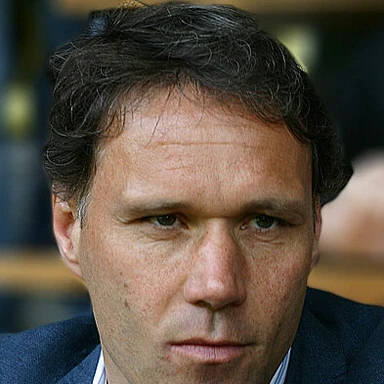 Photo: Paul Blank. Source and license in Image credits.
Scored Ajax’s winning goal in the 1987 Cup Winners’ Cup final under Cruyff.
 Photo: Žan Kolman. Source and license in Image credits.
Sporting CP · Barcelona · Real Madrid
1989—2009Worked together as player and head coach; see the overlapping club or national-team career entries.
 Photo: Mutari. Source and license in Image credits.
A versatile Ajax defender and midfielder in Cruyff’s 1987 Cup Winners’ Cup-winning squad.

Positional football architect
2007—2026 · Barcelona · Bayern Munich
Architect of Total Football
1960—1992 ·
Collective intensity and attacking freedom
2008—Present · Barcelona · Paris Saint-GermainCareer and honour facts cite their underlying sources, including clubs and governing bodies. Tactical readings are identified as editorial analysis.
AFC AjaxFrom player to coach: Cruyff in the 1980sAccessed 2026-09-03FC BarcelonaJohan Cruyff, coach 1988–1996Accessed 2026-09-03FBref / Sports ReferenceBarcelona 1991/92 — La Liga recordAccessed 2026-09-15FC BarcelonaTxiki Begiristain — Dream Team honour editionsAccessed 2026-09-15UEFA1992 UEFA Super Cup — Barcelona’s first titleAccessed 2026-09-15Federació Catalana de FutbolCruyff’s Catalonia appointment, 2009–2013Accessed 2026-09-14AFC AjaxCruyff’s Ajax coaching apprenticeshipAccessed 2026-09-14FC BarcelonaThe Barcelona Dream Team eraAccessed 2026-09-14FC BarcelonaBarcelona coaching records and honoursAccessed 2026-09-14Coaches’ VoiceJohan Cruyff — tactical analysisAccessed 2026-09-14FC BarcelonaMichael Laudrup on Cruyff’s coachingAccessed 2026-09-14FC BarcelonaCruyff’s influence on Barcelona’s footballAccessed 2026-09-14FC BarcelonaCruyff’s 1988 appointmentAccessed 2026-09-14UEFAMilan 4–0 Barcelona — 1994 final reportAccessed 2026-09-14