La Liga
Athletic Club · league
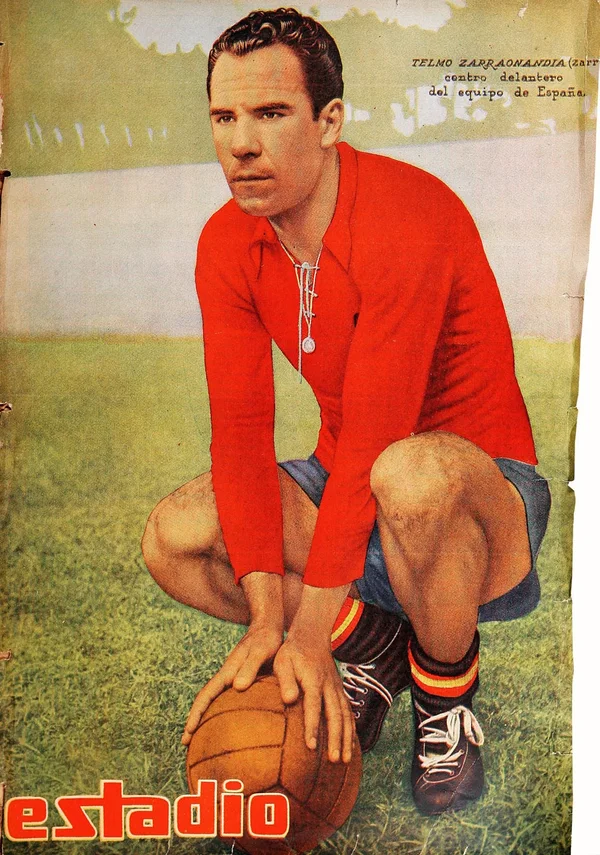 Photo: Unknown photographer / Estadio, 29 July 1950. Source and license in Image credits.
Telmo Zarraonandia Montoya
Athletic’s great centre-forward of the 1940s and early 1950s, Zarra paired powerful heading with sharp penalty-area movement. Six league scoring awards and the decisive goal against England in 1950 define his historical standing.
Senior international · all competitions
Stored archive snapshots, not live counters. Missing values are not zero; records with different scopes are never added together.
G/M = goals ÷ appearances. G+A = goals + assists. Per-90 metrics use documented minutes.
In context
His finishing was inseparable from Athletic’s celebrated forward line. He provided the destination for combinations and crosses, with teammates creating the angles that made his movement so difficult to follow.
Reading the game
His finishing was inseparable from Athletic’s celebrated forward line. He provided the destination for combinations and crosses, with teammates creating the angles that made his movement so difficult to follow.
Athletic’s 2021 centenary article gives 354 matches and 335 goals; its player archive lists 353 matches, and the 2006 obituary gives 353 matches and 334 goals. These conflicting club records are cited without constructing a combined career total.
Historical references support the chronology; tactical explanations are museum editorial analysis.
Historical references: Athletic: Zarra’s centenary biography ↗ · Athletic: Zarra’s player archive ↗ · Athletic: Zarra’s 2006 obituary and historical totals ↗
Career
| Period | Club |
|---|---|
| 1939—1940 | ErandioHe joined Athletic from Erandio in 1940. The move began fifteen seasons at the club he supported, rather than an immediate leap to an already established international career. Senior club · all competitions |
| 1940—1955 | Athletic ClubHis Athletic years ran from 1940 to 1955, bringing one league title, five Spanish Cups and an Eva Duarte Cup. The later 1956 league title belongs to the team after his departure. Senior club · all competitions |
| 1955—1956 | IndautxuAfter Athletic he played at Indautxu and Barakaldo. Those later stages are part of his playing career, but their unverified totals are not combined with Athletic’s historical figures. Senior club · all competitions |
| 1956—1957 | BarakaldoAfter Athletic he played at Indautxu and Barakaldo. Those later stages are part of his playing career, but their unverified totals are not combined with Athletic’s historical figures. Senior club · all competitions |
Stored archive snapshots, not live counters. Missing values are not zero; records with different scopes are never added together.
G/M = goals ÷ appearances. G+A = goals + assists. Per-90 metrics use documented minutes.
Honours
Athletic Club · league
Athletic Club · domestic cup
Athletic Club · domestic cup
La Liga · individual
Story
Club chapter
He joined Athletic from Erandio in 1940. The move began fifteen seasons at the club he supported, rather than an immediate leap to an already established international career.
Explore club contextClub chapter
Against Valladolid in the 1950 cup final, he scored once before the break and three times in extra time. The four-goal performance turned a 1–1 match into a 4–1 Athletic victory.
Explore club contextCareer chapter
After Athletic he played at Indautxu and Barakaldo. Those later stages are part of his playing career, but their unverified totals are not combined with Athletic’s historical figures.
Profile
Centre-forward
An area striker whose heading, timing and direct finishing gave Athletic a focal point. The assessment describes period-specific football and does not infer modern sprint or shot-quality measurements.
Arrive before the defender reacts
Heading as a finishing craft
Illustrative role zones · not tracking data
Editorial assessment
Historical role analysis
Seven qualitative bands · not measured scores
Editorial assessment of this period, not an official rating.
These bands are not percentiles or an overall ranking. The chart’s geometry represents ordered bands, not equal differences in ability.
Qualitative judgments describe football actions in context. They do not measure personality or medical fitness. Category assessments are editorial summaries, not averages. A lower defensive band describes the player’s role and contribution, not their value to the team.
Athletic: Zarra’s centenary biography ↗Reading the game
His penalty-area game depended on timing as well as strength. A short change of direction could create enough separation for a header or first-time finish without a long dribble.
The cross needed a destination, not merely a tall target. Zarra’s reputation rests on selecting the meeting point, preparing his jump and redirecting the ball towards goal.
Historical references: Athletic: Zarra’s centenary biography ↗ · RFEF: Zarra’s heading and 1950 World Cup legacy ↗
Reading the game
Against Valladolid in the 1950 cup final, he scored once before the break and three times in extra time. The four-goal performance turned a 1–1 match into a 4–1 Athletic victory.
Historical references: Athletic: Zarra’s centenary biography ↗
International
International career
The RFEF records twenty senior appearances and twenty goals between 1945 and 1951. His goal against England at the 1950 World Cup helped Spain reach the final four-team group, not a knockout semi-final.
Reading the game
Athletic’s great centre-forward of the 1940s and early 1950s, Zarra paired powerful heading with sharp penalty-area movement. Six league scoring awards and the decisive goal against England in 1950 define his historical standing.
Historical references: Athletic: Zarra’s centenary biography ↗
Archive
Poacher · editorial peak 1949—1951
Zarra and the post-war attack — Athletic Club

Barcelona
1999—2014
Barcelona · Al Sadd
1998—2019 Photo: Tam Tam. Source and license in Image credits.
FC Barcelona · Vissel Kobe · Emirates Club
2002—2024 Photo: Bryan Berlin. Source and license in Image credits.
Bryne · Molde · Red Bull Salzburg
2016—Present
Palmeiras · Real Madrid · Olympique Lyonnais
2022—Present Photo: Jonesy702. Source and license in Image credits.
Liverpool · Leeds United · Manchester City
1993—2012Statistics are displayed only within the scope supported by each cited source.
Athletic ClubAthletic: Zarra’s centenary biographyAthletic ClubAthletic: Zarra’s player archiveAthletic ClubAthletic: Zarra’s 2006 obituary and historical totalsRFEFRFEF: Zarra’s senior international registerRFEFRFEF: Zarra’s heading and 1950 World Cup legacy