8

La Liga
First · 1929–30
Latest · 1983–84View winning seasons
1929–30 · 1930–31 · 1933–34 · 1935–36 · 1942–43 · 1955–56 · 1982–83 · 1983–84
Athletic Club
Athletic Club connects Bilbao, Lezama and San Mamés through a tradition of competing with players born or developed in Euskal Herria. Its history combines early league dominance, cup success and a lasting local identity.
Overview
Historical assessment
Overall Historical Index
86/100Football Legends DB editorial assessment
Football Legends DB editorial / historical index. This is not an official FIFA or UEFA ranking, a live form table or a player rating.
Version 1.0: editors assess eight dimensions from 0–100 using the cited historical record. The overall score is their equally weighted arithmetic mean, rounded to the nearest whole number. Trophy totals are evidence, not points automatically added to a formula.
Assessment guide: 0–39 limited documented impact; 40–59 established national contribution; 60–79 sustained national or continental influence; 80–94 major international influence; 95–100 a historical benchmark across generations. These are editorial judgements, not measured percentiles. Missing evidence means no published index.
World titles and sustained success across eras inform the historical and international assessments. Scores may be revised when the evidence or editorial assessment changes.
Assessment notes · Editorial assessment of eight league titles, an extensive cup tradition, two UEFA Cup or Europa League finals and an influential development model. No European title is awarded for a lost final; the scores describe historical standing, not current playing strength.
Current chapter
Season
2026–27Verified
As of 5 October 2026, Edin Terzić leads Athletic in La Liga. His appointment begins a new coaching chapter after Ernesto Valverde’s third spell; the club’s player eligibility philosophy continues to frame recruitment and development.
Honours
First · 1929–30
Latest · 1983–84First · 1902–03
Latest · 2023–24First · 1984
Latest · 2021First · 1950
Latest · 1950First · 1902
Latest · 1902History
Founded in Bilbao in 1898, Athletic developed alongside the city’s industrial and maritime connections. Its official name is Athletic Club; “Athletic Bilbao” is a widely used geographical reference.
The RFEF recognises 24 Copa del Rey titles. Athletic’s own 25-cup total also includes the 1902 Coronation Cup, won by Club Bizcaya. That precursor is listed separately here and is not added to the Copa del Rey comparison row.
Fred Pentland’s team won the league and cup doubles of 1930 and 1931. Its attack helped establish Athletic as a major force in the early Spanish league.
Zarra, Panizo and Piru Gainza gave the post-war side a lasting attacking reference. The 1943 league and cup double and later cup wins belong to this distinct generation.
Javier Clemente led Athletic to consecutive league titles in 1983 and 1984 and the 1984 cup. Dani and Manu Sarabia offered different attacking routes within a fiercely competitive collective.
Explore the defining match ↗Marcelo Bielsa’s pressing and adventurous movement carried Athletic to the 2012 Europa League and Copa del Rey finals. Both ended in defeat; their footballing impact should not be confused with a trophy-winning season.
Explore the defining match ↗Ernesto Valverde’s third spell culminated in the 2024 Copa del Rey victory over Mallorca on penalties. The Williams brothers and captain Iker Muniain linked attacking speed to the end of a forty-year wait for the cup.
Explore the defining match ↗Defining games
Copa del Rey
Endika’s goal against Barcelona completed the league and cup double. The match is recorded as a sporting milestone without presenting the post-match violence as part of the club’s footballing identity.
UEFA Cup
Athletic Club 2–1 Juventus
Lost on away goals · 2–2 on aggregate
San Mamés
Athletic beat Juventus 2–1 at San Mamés but lost the 1977 UEFA Cup final on away goals after a 1–0 defeat in Turin. The home victory is not counted as a continental title.
UEFA Europa League
Athletic won 3–2 away to Manchester United in the first leg of the 2012 Europa League round of 16. Aggressive pressing and supporting runs challenged the hosts; the tie was later won 5–3 on aggregate.
Spanish Super Cup
Aduriz scored three times in the 4–0 first-leg win over Barcelona. A 1–1 draw in the return secured the 2015 Spanish Super Cup, separate from the 1984 title awarded for winning the league and cup double.
Copa del Rey
Athletic Club 1–1 RCD Mallorca
Won 4–2 on penalties
La Cartuja
After a 1–1 draw with Mallorca through extra time, Athletic won the shoot-out 4–2. The 2024 final ended the wait since the 1984 cup and returned the celebration to Bilbao’s estuary.
Legends
Forward
The early forward whose name became the league’s goalscoring award.
Striker
A prolific centre-forward in the first great championship-winning attack.
Left winger
His left-wing threat helped shape Athletic’s early league-winning teams.
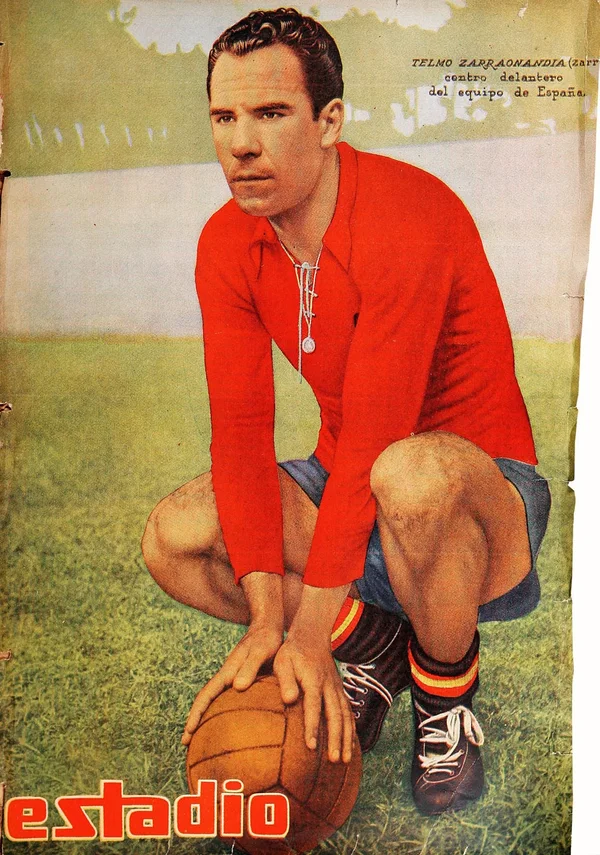 Photo: Unknown photographer / Estadio, 29 July 1950. Source and license in Image credits.
Striker
The club’s record goalscorer, an enduring reference for the central striker.
Forward
An inventive inside-forward in the celebrated post-war attacking line.
Left winger
The left winger whose longevity linked several post-war generations.
Goalkeeper
The goalkeeper who set Athletic’s record for official first-team appearances.
Right winger
A scoring right-sided forward and captain of the 1980s champions.
Forward
His technique and movement complemented the attack of Clemente’s champions.
Attacking midfielder
An academy-grown attacking midfielder and emblem of Athletic in the 1990s.
Right winger
A long-serving right winger who connected successive late-century and modern teams.
Striker
His aerial timing and finishing made the later-career striker a decisive reference.
The early forward whose name became the league’s goalscoring award.
A prolific centre-forward in the first great championship-winning attack.
His left-wing threat helped shape Athletic’s early league-winning teams.
Photo: Unknown photographer / Estadio, 29 July 1950. Source and license in Image credits.The club’s record goalscorer, an enduring reference for the central striker.
An inventive inside-forward in the celebrated post-war attacking line.
The left winger whose longevity linked several post-war generations.
The goalkeeper who set Athletic’s record for official first-team appearances.
A scoring right-sided forward and captain of the 1980s champions.
His technique and movement complemented the attack of Clemente’s champions.
An academy-grown attacking midfielder and emblem of Athletic in the 1990s.
A long-serving right winger who connected successive late-century and modern teams.
His aerial timing and finishing made the later-career striker a decisive reference.
Coaching legacy
Club tenure only. Honours include senior first-team league, cup, super cup, continental and world titles where verified. European titles count European Cup / Champions League wins.
1922–1926 · 1929–1933
Fred Pentland’s team won the league and cup doubles of 1930 and 1931. Its attack helped establish Athletic as a major force in the early Spanish league.
Selected historical coaching spells; current appointments appear in the dated current chapter.
1981–1986
Javier Clemente led Athletic to consecutive league titles in 1983 and 1984 and the 1984 cup. Dani and Manu Sarabia offered different attacking routes within a fiercely competitive collective.
Selected historical coaching spells; current appointments appear in the dated current chapter.
2011–2013
Marcelo Bielsa’s pressing and adventurous movement carried Athletic to the 2012 Europa League and Copa del Rey finals. Both ended in defeat; their footballing impact should not be confused with a trophy-winning season.
Selected historical coaching spells; current appointments appear in the dated current chapter.
Three spells: 2003–2005 · 2013–2017 · 2022–2026
Ernesto Valverde’s third spell culminated in the 2024 Copa del Rey victory over Mallorca on penalties. The Williams brothers and captain Iker Muniain linked attacking speed to the end of a forty-year wait for the cup.
Selected historical coaching spells; current appointments appear in the dated current chapter.

1992–1994 · 2001–2003
Jupp Heynckes led Athletic in two separate spells, 1992–1994 and 2001–2003.
Selected historical coaching spells; current appointments appear in the dated current chapter.
Club identity
Eligibility follows birth or football development in Euskal Herria, rather than nationality or ancestry alone. That distinction explains how different backgrounds can belong to the same team.
Lezama opened in 1971. Its role is not merely to produce saleable players: first-team succession is central to a club with a deliberately limited recruitment pool. Training, education and the links between age groups underpin that continuity.
The original San Mamés opened in 1913 and served Athletic for a century. The new stadium opened in 2013 beside its predecessor, retaining the name and the close connection between pitch, crowd and city.
The RFEF recognises 24 Copa del Rey titles. Athletic’s own 25-cup total also includes the 1902 Coronation Cup, won by Club Bizcaya. That precursor is listed separately here and is not added to the Copa del Rey comparison row.
A regional development model does not prescribe a single formation. Clemente’s champions, Bielsa’s pressing side and Valverde’s cup winners show distinct ways of organising the same club’s resources.
Founded in Bilbao in 1898, Athletic developed alongside the city’s industrial and maritime connections. Its official name is Athletic Club; “Athletic Bilbao” is a widely used geographical reference.
Identity
Stadium
Current home / Bilbao
The original San Mamés opened in 1913 and served Athletic for a century. The new stadium opened in 2013 beside its predecessor, retaining the name and the close connection between pitch, crowd and city.
Rivalries
The Basque derby connects Bilbao and San Sebastián through distinct local traditions. Sporting rivalry and shared regional roots coexist; neither fan base should be reduced to a single political identity.
Development
Founded · 1971
Lezama opened in 1971. Its role is not merely to produce saleable players: first-team succession is central to a club with a deliberately limited recruitment pool. Training, education and the links between age groups underpin that continuity.
Famous graduates
Collection
Kits
Home kit / 1983–84
Kit studies are abstract colour and pattern references, not reproductions of official shirts.
Records
Official first-team matches across the completed 1962–1980 Athletic career; friendlies are excluded.
Official first-team goals in Athletic’s completed Zarra career; this is a club total, not a Spain international or league-only figure.
Javier Clemente led Athletic to consecutive league titles in 1983 and 1984 and the 1984 cup. Dani and Manu Sarabia offered different attacking routes within a fiercely competitive collective.
Editorial assessment of eight league titles, an extensive cup tradition, two UEFA Cup or Europa League finals and an influential development model. No European title is awarded for a lost final; the scores describe historical standing, not current playing strength.
Ernesto Valverde’s third spell culminated in the 2024 Copa del Rey victory over Mallorca on penalties. The Williams brothers and captain Iker Muniain linked attacking speed to the end of a forty-year wait for the cup.