
League
First · 1935–36
Latest · 2022–23
Sport Lisboa e Benfica
A Lisbon institution with broad national support, Benfica joined domestic success to a defining European period under Béla Guttmann.
Overview
Historical assessment
Overall Historical Index
91/100Football Legends DB editorial assessment
Football Legends DB editorial / historical index. This is not an official FIFA or UEFA ranking, a live form table or a player rating.
Version 1.0: editors assess eight dimensions from 0–100 using the cited historical record. The overall score is their equally weighted arithmetic mean, rounded to the nearest whole number. Trophy totals are evidence, not points automatically added to a formula.
Assessment guide: 0–39 limited documented impact; 40–59 established national contribution; 60–79 sustained national or continental influence; 80–94 major international influence; 95–100 a historical benchmark across generations. These are editorial judgements, not measured percentiles. Missing evidence means no published index.
World titles and sustained success across eras inform the historical and international assessments. Scores may be revised when the evidence or editorial assessment changes.
Assessment notes · The assessment balances two European Cups and repeated finals against national dominance, a broad supporter network and an academy tradition spanning different homes.
Current chapter
Season
2026–27Verified
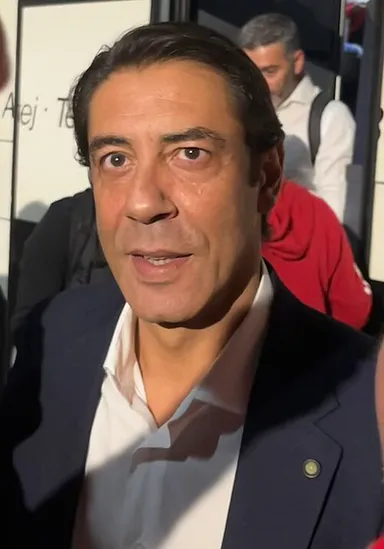
Presented in June 2026 alongside president Rui Costa, Marco Silva begins a new sporting cycle. The historical register remains at 38 league titles; this appointment is recorded separately from earlier managers’ honours.
Honours
First · 1935–36
Latest · 2022–23First · 1939–40
Latest · 2016–17First · 1929–30
Latest · 1934–35First · 2008–09
Latest · 2024–25First · 1980
Latest · 2025First · 1960–61
Latest · 1961–62First · 1950
Latest · 1950History
The club’s foundation predates its present stadium and academy buildings.
The old Luz opened in 1954. Glória’s work and players such as Coluna and Costa Pereira helped prepare the club for its European breakthrough.
Tactical identity · More systematic preparation around a technical core
Two league titles and two European Cups established a new continental power. The second final added Eusébio to an already successful side.
Tactical identity · Mobile attackers and direct combinations
Explore the defining match ↗Benfica reached further European Cup finals in 1963, 1965 and 1968, while Eusébio became the attack’s central reference.
Tactical identity · Goalscoring power around a durable midfield
Hagan’s third championship came with 28 wins and two draws. Eusébio scored forty league goals as younger figures gained experience.
Tactical identity · Fitness, collective discipline and varied finishing
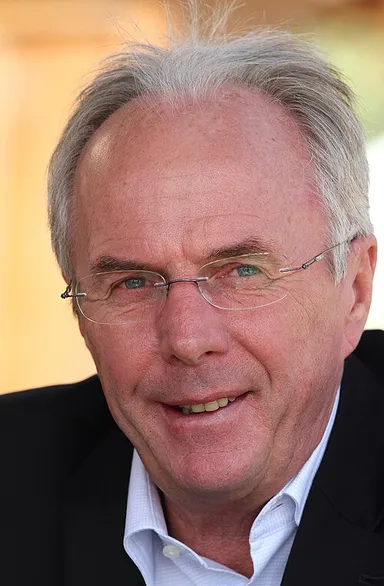
Eriksson and Toni led different title-winning teams. The club reached the 1983 UEFA Cup final and the 1988 and 1990 European Cup finals without adding a continental trophy.
Tactical identity · Compact organisation with technical midfield play
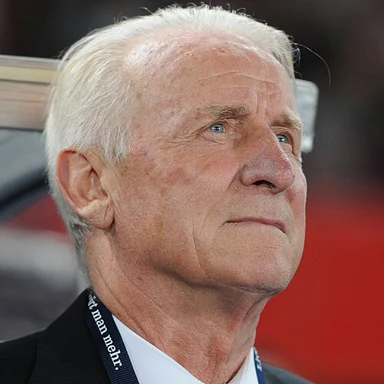
Trapattoni’s team ended the eleven-year league wait with Luisão and Simão among its central figures.
Tactical identity · Experienced defending and decisive attacking moments
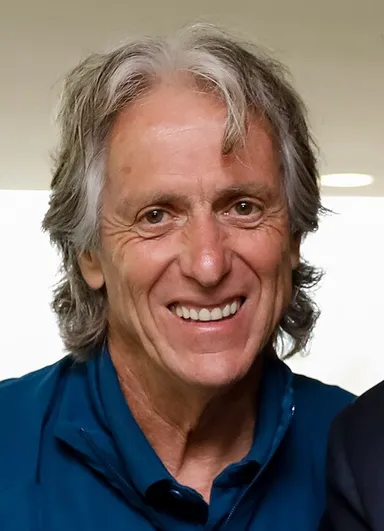
Explore the defining match ↗Jesus’s league-winning sides and Europa League finalists laid the ground for the run completed by Rui Vitória in 2017.
Tactical identity · High attacking occupation and complementary forwards
Explore the defining match ↗Lage won in 2019 and Schmidt in 2023. Seixal’s graduates became central to the club’s sporting development and player movement.
Tactical identity · Technical development feeding successive first teams
Defining games
European Cup final
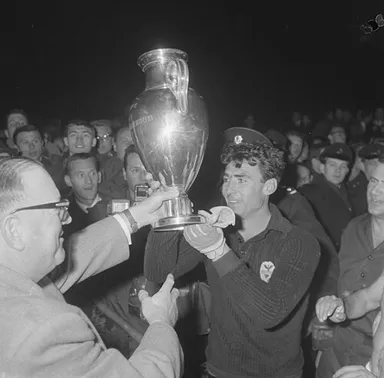
Águas and Coluna scored as Benfica became the first European Cup winner other than Real Madrid. The victory belonged to a team built before Eusébio’s breakthrough.
European Cup final
After trailing 2–0, Benfica recovered. Eusébio’s two second-half goals completed the turnaround against a Madrid team for whom Puskás scored a hat-trick.
Primeira Liga
Benfica 1–1 Boavista
Estádio do Bessa, Porto
A draw on the final day was enough for Trapattoni’s side to reclaim the league for the first time since 1994.
Europa League semi-final · second leg
Benfica protected its first-leg advantage despite Enzo Pérez’s dismissal, reaching a second successive Europa League final. The match was drawn; the tie was won.
Primeira Liga
Benfica 5–0 Vitória de Guimarães
Estádio da Luz, Lisbon
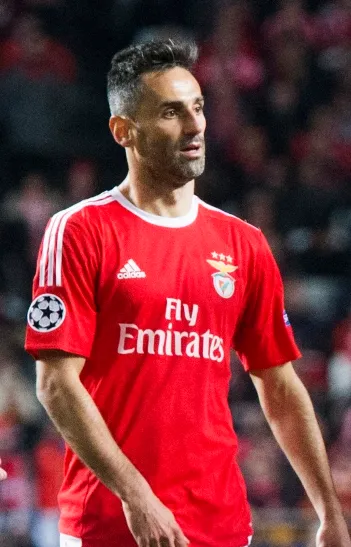
Jonas scored twice as Rui Vitória’s team secured Benfica’s first sequence of four straight league titles, continuing the run begun under Jesus.
Legends
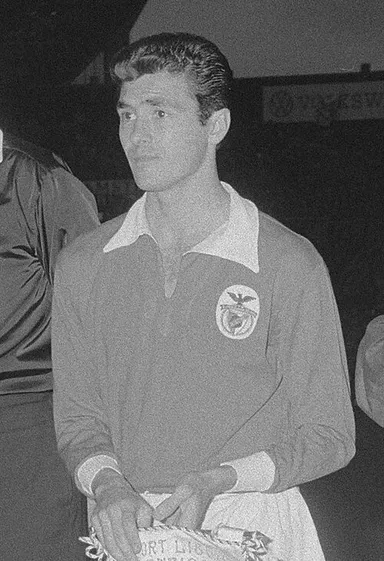
Photo: Jack de Nijs for Anefo
Nationaal Archief, Den Haag, Rijksfotoarchief: Fotocollectie Algemeen Nederlands Fotopersbureau (ANEFO), 1945-1989 - negatiefstroken zwart/wit, nummer toegang 2.24.01.05, bestanddeelnummer 913-8531. Source and license in Image credits.Forward
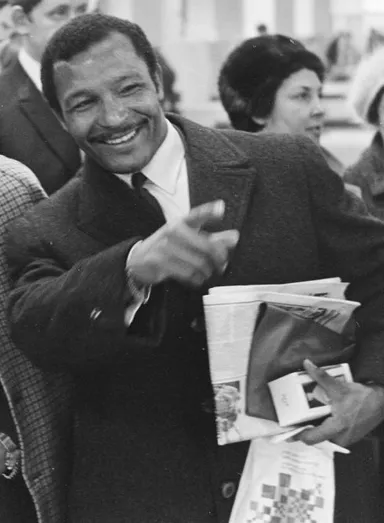
The centre-forward captained both European Cup-winning sides and supplied the penalty-area reference around which the attack moved.
Photo: Jack de Nijs for Anefo. Source and license in Image credits.Goalkeeper
The goalkeeper of the 1961 and 1962 champions connected Glória’s rebuilding to Guttmann’s European success.
Photo: Nationaal Archief, Den Haag, Rijksfotoarchief: Fotocollectie Algemeen Nederlands Fotopersbureau (ANEFO), 1945-1989 - negatiefstroken zwart/wit, nummer toegang 2.24.01.05, bestanddeelnummer 922-0864. Source and license in Image credits.Midfielder
A midfield organiser with authority and a powerful shot, he scored in both victorious European finals.
Photo: Panini. Source and license in Image credits.Forward
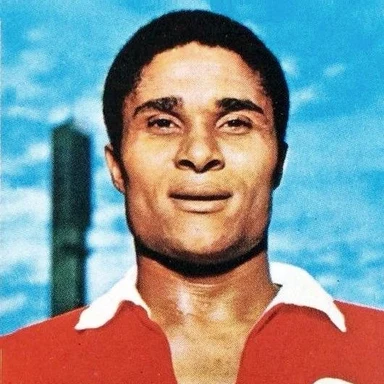
Acceleration and forceful finishing transformed the 1962 final. He remained the attacking reference through a decade of league titles and further European finals.
Photo: Bert Verhoeff for Anefo. Source and license in Image credits.Winger
A youth graduate whose left-wing combinations helped balance the attack beside Eusébio and Águas.
Forward
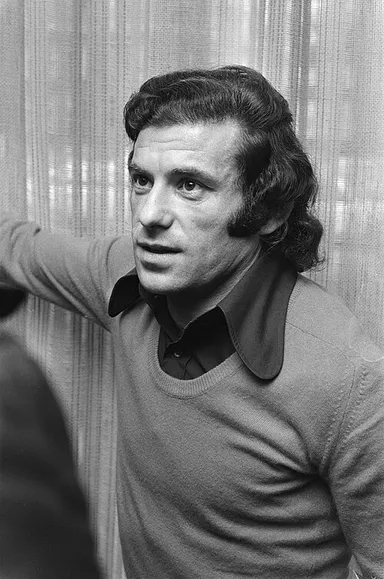
A fast winger who became a prolific forward, bridging the late Eusébio years and the teams of the 1980s.
Photo: Adzio92. Source and license in Image credits.Defender
A commanding centre-back and captain, he returned from spells abroad to lead another Benfica generation.
Photo: Fortin146. Source and license in Image credits.Goalkeeper
An agile goalkeeper whose long association with the club began in 1972; his emergence as first choice accompanied the team’s renewal in the late 1970s.
Winger
Close control and changes of direction made the academy graduate a creative focus, before and after his spell at Bordeaux.
Photo: Ser!. Source and license in Image credits.Midfielder
The academy-trained playmaker helped win the 1994 league, built a career in Italy and returned for his final two seasons.
Photo: Reto Stauffer, www.hopp-schwiiz.ch. Source and license in Image credits.Defender
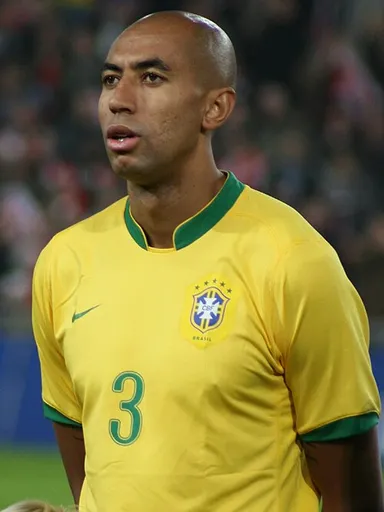
A centre-back and long-serving captain whose fifteen years spanned the 2005 revival and four consecutive league titles.
Photo: Вячеслав Евдокимов. Source and license in Image credits.Forward
Movement between the lines and composed finishing brought 137 goals and four league titles during his Benfica career.
The centre-forward captained both European Cup-winning sides and supplied the penalty-area reference around which the attack moved.
The goalkeeper of the 1961 and 1962 champions connected Glória’s rebuilding to Guttmann’s European success.
A midfield organiser with authority and a powerful shot, he scored in both victorious European finals.
Acceleration and forceful finishing transformed the 1962 final. He remained the attacking reference through a decade of league titles and further European finals.
A youth graduate whose left-wing combinations helped balance the attack beside Eusébio and Águas.
A fast winger who became a prolific forward, bridging the late Eusébio years and the teams of the 1980s.
A commanding centre-back and captain, he returned from spells abroad to lead another Benfica generation.
An agile goalkeeper whose long association with the club began in 1972; his emergence as first choice accompanied the team’s renewal in the late 1970s.
Close control and changes of direction made the academy graduate a creative focus, before and after his spell at Bordeaux.
The academy-trained playmaker helped win the 1994 league, built a career in Italy and returned for his final two seasons.
A centre-back and long-serving captain whose fifteen years spanned the 2005 revival and four consecutive league titles.
Movement between the lines and composed finishing brought 137 goals and four league titles during his Benfica career.
His Madrid record closes at 190 official appearances and 36 goals; PSG’s post-farewell review records 295 matches, 92 goals and 111 assists. These club figures remain separate from his completed Argentina career of 145 appearances and 31 goals, and from the ongoing Rosario return.
Coaching legacy
Club tenure only. Honours include senior first-team league, cup, super cup, continental and world titles where verified. European titles count European Cup / Champions League wins.
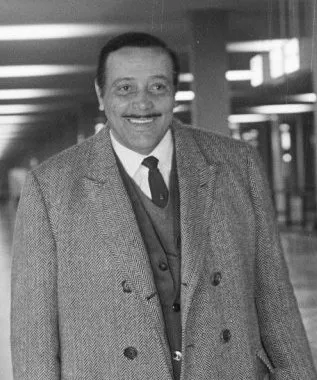
Photo: Eric Koch for Anefo Nationaal Archief, Den Haag, Rijksfotoarchief: Fotocollectie Algemeen Nederlands Fotopersbureau (ANEFO), 1945-1989 - negatiefstroken zwart/wit, nummer toegang 2.24.01.05, bestanddeelnummer 922-0796. Source and license in Image credits.1954–1959 · 1968–1970
Professionalised training and team preparation, winning league titles in two separate spells.
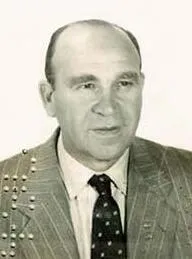
Photo: Unknown authorUnknown author. Source and license in Image credits.1959–1962 · 1965–1966
Built the two European Cup-winning teams around rapid attacking combinations; his later return did not add a European title.
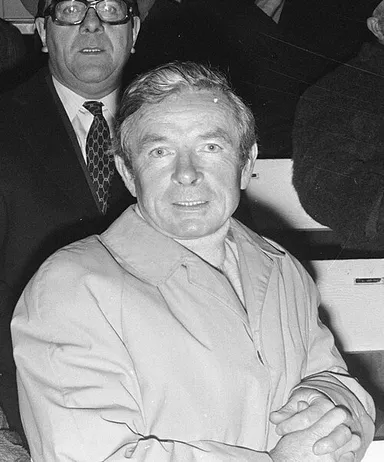
Photo: Hans Peters for Anefo. Source and license in Image credits.1970–1973
Three consecutive championships culminated in the unbeaten 1972–73 league season.
Photo: Doha Stadium Plus Qatar. Source and license in Image credits.1982–1984 · 1989–1992
Combined collective organisation with technical midfielders, reaching the 1983 UEFA Cup and 1990 European Cup finals.
1987–1989 · 1992–1994 · 2000–2002
A former midfield leader who returned as coach, winning the 1989 and 1994 championships.
Photo: Michael Kranewitter, Wikimedia Commons, CC BY-SA 3.0 AT; crop by Heiko Gerber. Source and license in Image credits.2004–2005
Ended an eleven-year league wait through an experienced, pragmatic team.
Photo: Palácio do Planalto. Source and license in Image credits.2009–2015 · 2020–2021
Restored sustained title contention and reached successive Europa League finals; runner-up finishes are not European titles.
Club identity
From Guttmann’s mobile attack to Eriksson’s organisation, the club’s strongest teams have joined technical players to a coherent collective structure.
Members, elected leadership and the Casas do Benfica network connect the first team to a much wider association.
The 1960s side brought together players from Portugal and Mozambique. Later eras combined international recruitment with academy graduates, rather than following one unchanging model.
Seixal combines football coaching with academic and social support; the youth tradition predates the campus opened in 2006.
The Luz name survived the replacement of the old stadium. Supporter memory links both grounds, red-and-white colours and the eagle emblem.
The consecutive European Cups are the central achievement; later final defeats remain part of the story without being turned into superstition or omitted.
Identity
Stadium
Current home / Lisbon
Opened on 25 October 2003. The new ground retained the Luz identity while replacing the original stadium nearby.
Former home / Lisbon
Opened on 1 December 1954 through a long effort to secure a permanent home. It hosted the European champions and successive generations until March 2003.
Rivalries
A national rivalry between Lisbon and Porto, shaped by repeated championship races and cup finals.
Benfica’s European breakthrough came in the 1960s; Porto’s domestic transformation and later European titles shifted the competitive balance. Their cup meetings include Benfica’s 1931 victory in the old knockout championship.
Development
Founded · 2006
The campus opened on 22 September 2006; Benfica’s youth system is older.
Football development is accompanied by schooling and social support, with preparation for first-team demands and life beyond the pitch.
Historical role
Simões, Chalana and Rui Costa represent earlier youth routes. Bernardo Silva, Rúben Dias and João Félix link the club’s modern development work to wider European football. Eusébio arrived as a senior recruit and is not classified here as an academy graduate.
Famous graduates
Collection
Kits
Home kit / 1961–62
Home kit / 1972–73
Home kit / 2016–17
Commercial
TECHNICAL SUPPLIER
TECHNICAL SUPPLIER
MAIN SHIRT
Kit studies are abstract colour and pattern references, not reproductions of official shirts.
Records
Club competitive-match convention. The separately published total of 802 includes friendlies and is not used here.
As of 2026-09-15The 1950 Latin Cup is displayed separately and is not a UEFA European Cup.
As of 2026-09-15