The football behind Pelé’s ratings
- Finishing variety
- Generational
- First touch and combination play
- Generational
- Passing weight and disguise
- Generational
- Aerial timing
- Generational
- Attacking decisions
- Generational
- Defensive responsibility
- Limited
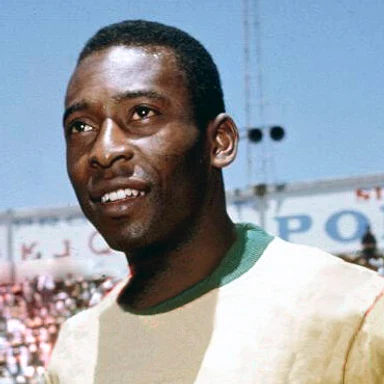 Photo: Unknown author. Source and license in Image credits.
Edson Arantes do Nascimento
Pelé joined finishing with either foot, aerial timing and close combinations to an increasingly expansive creative role for Santos and Brazil.
Senior club · all competitions
Completed club records only; not a complete career total.
Active club snapshots and records with another scope are excluded. Assist totals are not combined across incompatible definitions.
Stored archive snapshots, not live counters. Missing values are not zero; records with different scopes are never added together.
G/M = goals ÷ appearances. G+A = goals + assists. Per-90 metrics use documented minutes.
Senior international · all competitions
Brazil · senior international record, 1957–1971
Stored archive snapshots, not live counters. Missing values are not zero; records with different scopes are never added together.
G/M = goals ÷ appearances. G+A = goals + assists. Per-90 metrics use documented minutes.
In context
A complete attacking reference whose scoring threat created room for teammates, and whose club and international careers brought Brazilian football to a worldwide audience.
Reading the game
Pelé matters because he makes the distinction between scorer and creator feel inadequate. He could finish an attack with either foot or a timed header, then begin the next one by receiving behind midfield, drawing a defender and releasing a teammate. Those were connected actions: the threat of his own finish made his passing more dangerous, while his combinations created the room to score. Santos gave that range a sustained club setting, with Coutinho offering a close partner and wide attackers stretching the opposition. Brazil’s 1970 team supplied a different arrangement, in which Pelé could connect other exceptional players without having to occupy every attacking space himself. His three World Cup titles are the familiar entry point, but they describe different contributions, including an injury-shortened tournament in 1962. The football is more revealing than a single monumental goal total. Watching his movement, body shape and decisions shows why a number ten could also be a formidable penalty-area forward, and why technical imagination worked best when a teammate understood the next action.
Historical references support the chronology; tactical explanations are museum editorial analysis.
Historical references: FIFA: Pelé’s World Cup career and creative contribution ↗ · Santos: Pelé’s 1962 performance against Benfica ↗ · FIFA: the dummy against Uruguay and the shot that missed ↗
Career
| Period | Club | Goals |
|---|---|---|
| 1956—1974 | SantosUses the 643 competitive goals distinguished in Santos’ historical statement. Its wider 1,091-goal record includes 448 goals in friendlies and friendly competitions. A matching appearance total under precisely this convention has not been reconciled, so appearances remain blank; the club’s 1,116 appearances must not be paired with 643 as though they shared one scope. Senior club · all competitions Senior · #10 | 643 |
| 1975—1977 | New York CosmosNASL competitive record including playoffs, excluding the cancelled 1975 match. RSSSF lists 65 appearances with that cancelled match included; the retained record is therefore 64 with the same 37 goals. The club’s 106-match, 64-goal farewell account includes exhibitions and is a different scope. Regular-season assists are not a complete all-competition assist total. Senior club · all competitions Senior · #10Performance record
| 37 |
Stored archive snapshots, not live counters. Missing values are not zero; records with different scopes are never added together.
G/M = goals ÷ appearances. G+A = goals + assists. Per-90 metrics use documented minutes.
Honours
Santos · league
Santos · league
Santos · league
Santos · continental
Santos · world
Santos · world
New York Cosmos · league
Brazil · world
Pelé · individual
Story
Career chapter
Pelé joined Santos in 1956 and quickly developed beyond the promise attached to a talented teenager. The club gave him experienced teammates, repeated competitive demands and room to combine close control with finishing. At the 1958 World Cup he entered Brazil’s campaign after its first two matches. His goal against Wales opened the knockout run, followed by a hat-trick against France and two goals in the final against Sweden. This was an extraordinary arrival, but it belonged to a functioning team with several sources of creativity. The young forward’s distinction was how confidently he turned that support into decisive actions near goal.
Historical references: RSSSF: Pelé’s international match ledger ↗ · Santos: Pelé’s farewell and principal honours ↗
Career chapter
Santos became a setting for repeated attacking invention, with Pelé and Coutinho exchanging passes close enough to unsettle tightly packed defences. The 1962 Intercontinental Cup in Lisbon supplied a vivid example: Pelé scored three times as Santos defeated Benfica in the second leg. The Libertadores title was retained in 1963, extending the team’s continental authority. Brazil’s story was more interrupted. Injury limited Pelé’s involvement in the 1962 World Cup, while the 1966 tournament ended in the group stage amid physical punishment. Keeping these episodes together avoids confusing three winner’s medals with three identical individual campaigns, or overlooking the sustained quality of his Santos years.
Historical references: FIFA: Pelé’s World Cup career and creative contribution ↗ · RSSSF: Pelé’s international match ledger ↗ · Santos: Pelé’s 1962 performance against Benfica ↗ · Santos: retaining the Libertadores at the Bombonera ↗
Career chapter
By 1970, Pelé’s influence could be seen as clearly in a pass or a pause as in a burst towards goal. Zagallo’s Brazil brought him together with Tostão, Jairzinho, Gérson and Rivellino, requiring an understanding of complementary movements. He scored four times in Mexico, but the final against Italy also showed the value of waiting: his pass released Carlos Alberto into the right channel for the fourth goal. The famous dummy against Uruguay ended with a missed shot, an essential detail rather than an inconvenience. The tournament displayed inventive choices and shared understanding, not an unbroken sequence of perfect executions.
Historical references: FIFA: Pelé’s World Cup career and creative contribution ↗ · RSSSF: Pelé’s international match ledger ↗ · FIFA: the dummy against Uruguay and the shot that missed ↗
Career chapter
Pelé ended his senior Brazil career in 1971 and said farewell to regular Santos football in 1974. Joining the Cosmos in 1975 reopened his playing career in a different setting, where attracting an audience was part of the club’s significance. The football still had a competitive conclusion: New York won the 1977 Soccer Bowl with Pelé in the team. His October farewell against Santos was a separate exhibition, with a half for each side. That distinction matters when reading his totals. Tours and ceremonial matches helped carry his name worldwide, but they should not silently become league appearances or competitive goals.
Historical references: RSSSF: Pelé’s international match ledger ↗ · Santos: Pelé’s farewell and principal honours ↗ · New York Cosmos: Pelé’s championship and farewell exhibition ↗
Profile
Complete Forward
Also plays · Trequartista / Inside Forward
Receives between lines, protects several next actions and combines before returning to scoring positions. Finishing with either foot and a timed leap complements the passing, pauses and disguised releases of the mature number ten.
Finishing variety
First touch and combination play
Passing weight and disguise
Aerial timing
Illustrative role zones · not tracking data
Pelé’s first touch often kept both the pass and the turn available. Receiving between midfield and defence, he could protect the ball, combine with a nearby forward or face the goal if his marker hesitated. This is an editorial reading of his attacking value: control was not an isolated flourish, but a way to preserve options. A defender who stepped too close risked being turned; one who stayed away gave him time to see the next run. The danger began before the final pass or shot.
The combination with Coutinho illustrates a principle that also worked with Brazil: after releasing the ball, Pelé remained part of the attack. A short exchange could move the defender’s attention, allowing the return pass to reach a different angle or a more advanced position. The movement mattered as much as the touch. This made him useful alongside another central forward rather than dependent on being the sole striker. He could help a teammate receive, then arrive to finish the very move he had helped construct.
His finishing range forced defenders to protect different heights and directions. He could strike with either foot, adjust after a close-control action or attack a cross through the timing of his leap. The 1958 final and the opening header against Italy in 1970 show why his aerial play belongs within the profile of a technical forward. It was not simply a question of height. Separation, take-off and the choice of contact made the header another route to goal when the ground-level route was crowded.
The mature Pelé could slow an individual action without slowing the attack. By holding the ball long enough to draw a response, he let a runner reach the useful space before releasing the pass. Carlos Alberto’s goal in the 1970 final is a clear reference for this reading. The action depends on the whole team’s work and on the receiver’s timing; it is not proof that one player created everything. Pelé’s contribution was to recognise the opening and give the next player a playable ball.
Historical references: FIFA: Pelé’s World Cup career and creative contribution ↗ · RSSSF: Pelé’s international match ledger ↗ · Santos: Pelé’s 1962 performance against Benfica ↗ · Santos: retaining the Libertadores at the Bombonera ↗ · FIFA: the dummy against Uruguay and the shot that missed ↗
Reading the game
| Era / team | Primary Role | Tactical Character |
|---|---|---|
| 1956–1958Santos / Brazil | The young inside-forward | Combine near another forward, then attack the space to finish. |
| 1959–1966Santos | Santos’ scorer and combination partner | Join close exchanges to carrying, shooting and aerial threat. |
| 1967–1971Brazil | The mature attacking connector | Receive between lines and release the complementary runs of the wider attack. |
| 1975–1977New York Cosmos | The experienced Cosmos forward | Bring combinations and finishing to a new league setting. |
Historical references: FIFA: Pelé’s World Cup career and creative contribution ↗ · RSSSF: Pelé’s international match ledger ↗ · Santos: Pelé’s farewell and principal honours ↗ · Santos: Pelé’s 1962 performance against Benfica ↗ · Santos: retaining the Libertadores at the Bombonera ↗ · FIFA: the dummy against Uruguay and the shot that missed ↗ · New York Cosmos: Pelé’s championship and farewell exhibition ↗
Reading the game
His own scoring threat made defenders commit, but he did not always answer that attention with a shot. A lay-off or a disguised pass could transfer the advantage to a teammate. The breadth of the forward matters here: creation and finishing reinforced each other rather than competing for his attention.
Pelé’s leap gave his attack another dimension, but the useful detail is the preparation around it. Movement separated him from a marker, while timing let him meet the ball decisively. His header in the 1970 final is a reminder that a technically gifted number ten can also solve a direct penalty-area problem.
Against Uruguay in 1970, he let the ball run past the goalkeeper and moved around the other side before shooting wide. Keeping the miss in the story makes the example more useful. The invention lay in seeing a route without touching the ball; execution and outcome remained separate questions.
Santos tours and the later Cosmos chapter made his football visible far beyond a domestic league audience. That reach is part of the legacy even when those matches sit outside competitive statistics. Appreciating their cultural importance does not require adding every exhibition goal to a formally scoped scoring record.
Historical references: FIFA: Pelé’s World Cup career and creative contribution ↗ · Santos: 643 competitive goals and the wider 1,091-goal record ↗ · Santos: Pelé’s 1962 performance against Benfica ↗ · FIFA: the dummy against Uruguay and the shot that missed ↗ · New York Cosmos: Pelé’s championship and farewell exhibition ↗
Reading the game
Inside-forward in Brazil’s attack
Four World Cup appearances brought six goals, with the knockout matches revealing sharp control, quick finishing and aerial timing. This version focuses on the teenager’s capacity to turn support into decisive actions. It is not a claim that his creative role was already identical to the one he would play twelve years later.
Complete forward alongside Coutinho
The club version centres on combinations, acceleration and finishing variety, with the Lisbon hat-trick providing a decisive reference. Santos’ domestic and continental football reveals a prime that the injury-shortened World Cup cannot describe on its own. Club performance and tournament availability are separate parts of the assessment.
Free attacking connector for Brazil
The shared reference for both rating panels is the 1970 World Cup. Four goals and FIFA’s six-assist tally accompany the wider contribution: finding runners, shaping the next pass and returning to scoring positions. This snapshot values mature decision-making without importing every physical quality of the younger Santos version.
Historical references: FIFA: Pelé’s World Cup career and creative contribution ↗ · RSSSF: Pelé’s international match ledger ↗ · Santos: Pelé’s 1962 performance against Benfica ↗ · Santos: the 1962 Paulista title and Pelé’s 37 goals ↗
Statistics
| Season | Club | Apps | Goals | G/M |
|---|---|---|---|---|
| 1977 · NASL regular season | New York Cosmos Senior club · league only Performance record
| 25 | 13 | 0.52 |
| 1976 · NASL regular season | New York Cosmos Senior club · league only Performance record
| 22 | 13 | 0.59 |
| 1975 · NASL regular season | New York Cosmos Senior club · league only Performance record
| 9 | 5 | 0.56 |
| 1974 · Campeonato Brasileiro | Santos Senior club · league only | 17 | 9 | 0.53 |
| 1973/74 · Campeonato Brasileiro | Santos Senior club · league only | 30 | 19 | 0.63 |
| 1972 · Campeonato Brasileiro | Santos Senior club · league only | 16 | 5 | 0.31 |
| 1971 · Campeonato Brasileiro | Santos Senior club · league only | 21 | 1 | 0.05 |
| 1970 · Torneio Roberto Gomes Pedrosa | Santos Senior club · league only | 13 | 4 | 0.31 |
| 1969 · Torneio Roberto Gomes Pedrosa | Santos Senior club · league only | 12 | 12 | 1.00 |
| 1968 · Torneio Roberto Gomes Pedrosa | Santos Senior club · league only | 17 | 11 | 0.65 |
Stored archive snapshots, not live counters. Missing values are not zero; records with different scopes are never added together.
G/M = goals ÷ appearances. G+A = goals + assists. Per-90 metrics use documented minutes.
Selected league coverage, not complete annual totals: Santos rows cover the Paulista in 1957–1966, the Roberto Gomes Pedrosa tournament in 1967–1970 and the national championship in 1971–1974. The 1973/74 label follows the source’s edition label. State and national tournaments overlapped, so later Paulista matches and other competitions are absent here. New York rows are regular season only: 56 appearances, 31 goals and 25 assists, excluding playoffs. Historical Santos assists remain unverified. Do not sum these rows as a complete club career.
Club competitions
| Competition | Apps | Goals | G/M |
|---|---|---|---|
Campeonato PaulistaPaulista · RSSSF scope, 1957–1974RSSSF’s regional championship tally, kept separate from national competitions. The season register contains only the earlier part of this Paulista career, so its rows are not a full reconciliation of this total. | 410 | 467 | 1.14 |
Intercontinental CupIntercontinental Cup · 1962 and 1963Three appearances and seven goals in the competition. The three-goal Lisbon performance belongs to the 1962 second leg, not to a friendly tour. | 3 | 7 | 2.33 |
Stored archive snapshots, not live counters. Missing values are not zero; records with different scopes are never added together.
G/M = goals ÷ appearances. G+A = goals + assists. Per-90 metrics use documented minutes.
International
International career
Three World Cup titles came in 1958, 1962 and 1970, with different individual contributions. Injury ended his involvement after two matches in 1962. Across four World Cups he played fourteen matches and scored twelve goals. His only South American Championship was the first 1959 tournament in Argentina, where Brazil finished second and he scored eight goals.
Senior international · tournament splits
| Competition | Apps | Goals | G/M |
|---|---|---|---|
FIFA World CupWorld Cup finals · 1958–1970Four finals tournaments, excluding qualifiers. The 1962 medal is retained while his two appearances make the injury-limited contribution explicit. A complete cross-edition assist total is not inferred from one tournament. | 14 | 12 | 0.86 |
FIFA World CupMexico 1970 · FIFA assist conventionFIFA credits six assists in this tournament. This edition is already included in the fourteen-match World Cup total and is not an additional block of appearances. Performance record
| 6 | 4 | 0.67 |
Copa AméricaSouth American Championship · Argentina 1959His single South American Championship appearance was in the Argentina edition. The separate 1959 Ecuador tournament is not included; the runners-up finish is not a championship honour. | 6 | 8 | 1.33 |
Stored archive snapshots, not live counters. Missing values are not zero; records with different scopes are never added together.
G/M = goals ÷ appearances. G+A = goals + assists. Per-90 metrics use documented minutes.
Reading the game
Pelé left football a broad model of the attacking player. The number ten could create, combine and still arrive as the scorer; athletic power and technical subtlety could support the same action. His career also asks for historical perspective. Santos’ regional championships, national competitions and international tours belonged to a calendar unlike the modern European league season. Those settings should be explained on their own terms, with clearly separated statistics, rather than squeezed into a misleading total. The same care improves the World Cup story: the teenage impact of 1958, the injury in 1962 and the mature influence of 1970 are distinct achievements and experiences. None requires treating his teammates as background figures. His importance grew through the connections he made with them, and through the audiences who encountered Brazilian football through his play. For the modern viewer, the enduring lesson is practical as well as historical. Watch what his scoring threat does to a defender, then watch how he uses the space it gives somebody else. That relationship explains more than a superlative ever could.
Historical references: FIFA: Pelé’s World Cup career and creative contribution ↗ · Santos: 643 competitive goals and the wider 1,091-goal record ↗ · Santos: Pelé’s 1962 performance against Benfica ↗ · New York Cosmos: Pelé’s championship and farewell exhibition ↗
Archive
Complete Forward · editorial peak 1970—1970
Lula · Antoninho · Vicente Feola · Aymoré Moreira · Mário Zagallo · Gordon Bradley · Eddie Firmani
Garrincha— Overlapping Brazil era
The dream attack and world champions — Santos · Renewal around the great survivors — Santos

Cruzeiro · PSV · Barcelona
1993—2011 Photo: Marcos Corrêa/PR. Source and license in Image credits.
Grêmio · Paris Saint-Germain · FC Barcelona
1998—2018 Photo: Евгений Асмолов. Source and license in Image credits.
São Paulo · AC Milan · Real Madrid
2001—2017
AS Monaco · Juventus · Arsenal
1994—2014Cruzeiro · PSV · Barcelona
1993—2011 Photo: Paul Blank. Source and license in Image credits.
Statistics are displayed only within the scope supported by each cited source.
FIFAFIFA: Pelé’s World Cup career and creative contributionFIFAFIFA: Pelé’s senior Brazil recordRSSSFRSSSF: Pelé’s international match ledgerRSSSFRSSSF: Pelé’s competition scopes and cancelled matchesSantos FCSantos: 643 competitive goals and the wider 1,091-goal recordSantos FCSantos: Pelé’s farewell and principal honoursSantos FCSantos: the championships of Pelé’s eraSantos FCSantos: Pelé’s 1962 performance against BenficaSantos FCSantos: the 1962 Paulista title and Pelé’s 37 goalsSantos FCSantos: retaining the Libertadores at the BomboneraFIFAFIFA: the dummy against Uruguay and the shot that missedNew York CosmosNew York Cosmos: Pelé’s championship and farewell exhibitionNASL JerseysNASL archive: Pelé’s regular-season appearances and assistsNational Football TeamsNational Football Teams: Pelé’s dated league recordsFIFAPelé’s three World CupsWikipedia (cited biographical reference)Pelé — biographical and career reference