The football behind Pavel Nedvěd’s ratings
- Two-footed striking
- Generational
- Repeated attacking and recovery runs
- Generational
- Direct carrying and combinations
- Elite
- Timed midfield arrivals
- Elite
- Passing decisions
- Excellent
- Defensive discipline
- Good
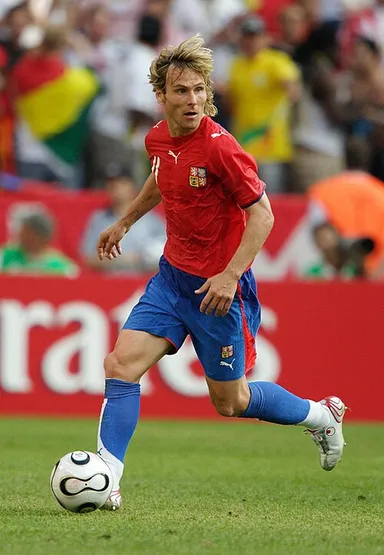 Photo: Pavel Lebeda. Source and license in Image credits.
Pavel Nedvěd
A two-footed midfielder who joined left-sided progression, powerful shooting and repeated attacking runs with sustained recovery work.
Senior club · all competitions
Completed club records only; not a complete career total.
Active club snapshots and records with another scope are excluded. Assist totals are not combined across incompatible definitions.
Stored archive snapshots, not live counters. Missing values are not zero; records with different scopes are never added together.
G/M = goals ÷ appearances. G+A = goals + assists. Per-90 metrics use documented minutes.
Senior international · all competitions
Czech Republic · official senior career, 1994–2006
Stored archive snapshots, not live counters. Missing values are not zero; records with different scopes are never added together.
G/M = goals ÷ appearances. G+A = goals + assists. Per-90 metrics use documented minutes.
In context
His influence came from connecting demanding actions: carry, combine, arrive and recover.
Reading the game
Pavel Nedvěd made attacking skill and sustained physical effort feel like parts of the same action. He could carry the ball from the left, combine inside and then continue towards the penalty area, while still having the willingness to recover when the move broke down. The threat came from the sequence rather than from one fixed position. Defenders also had to respect his ability to strike with either foot: guiding him towards the other side did not reliably remove the shot. Sparta developed the midfielder before Lazio gave that range a setting in an ambitious Italian team. Juventus then asked him to connect midfield and attack after Zidane’s departure, a responsibility he interpreted through movement and directness rather than imitation. The Czech national team added another collective setting, particularly the adventurous side of 2004. Calling him tireless describes something visible but leaves the important questions unanswered: where did he run, when did he release the ball and how did his next movement help a teammate? His place in football history rests on answering those questions with technique and judgment as well as energy.
Historical references support the chronology; tactical explanations are museum editorial analysis.
Historical references: Juventus Hall of Fame: Pavel Nedvěd ↗ · UEFA: the versatile two-footed midfielder’s career ↗ · EURO 2004: the Czech comeback against the Netherlands ↗
Career
| Period | Club | Apps | Goals | G/M |
|---|---|---|---|---|
| 1991—1992 | Dukla PrahaThe documented top-flight spell is 1991/92: 19 league appearances and three goals. Earlier development in Plzeň and military football at Tábor is outside this verified senior league series, not assigned invented appearance totals. Senior club · league only | 19 | 3 | 0.16 |
| 1992—1996 | Sparta PragueFour league seasons total 98 appearances and 23 goals. The Czech FA records 18 appearances in 1992/93, preferred over NFT’s 17. The final Czechoslovak league season is followed by three Czech league seasons; cup and European games are excluded. Senior club · league only | 98 | 23 | 0.23 |
| 1996—2001 | LazioLazio’s completed official record is 207 appearances and 51 goals. The Serie A subset is 138/33, already included in this wider total. Complete historical assists have not been reconciled and remain null. Senior club · all competitions Senior · #18 | 207 | 51 | 0.25 |
| 2001—2009 | JuventusJuventus record 327 competitive appearances and 65 goals. League rows total 247/51, including 33/11 in Serie B in 2006/07. Official Serie A honours include 2001/02 and 2002/03; the removed 2004/05 and 2005/06 titles are excluded despite the club archive’s four-title presentation. Senior club · all competitions Senior · #11 | 327 | 65 | 0.20 |
Stored archive snapshots, not live counters. Missing values are not zero; records with different scopes are never added together.
G/M = goals ÷ appearances. G+A = goals + assists. Per-90 metrics use documented minutes.
Honours
Sparta Prague · league
Sparta Prague · league
Sparta Prague · domestic cup
Lazio · league
Lazio · domestic cup
Lazio · domestic cup
Lazio · continental
Lazio · continental
Juventus · league
Juventus · domestic cup
Juventus · league
Pavel Nedvěd · individual
Pavel Nedvěd · individual
Pavel Nedvěd · individual
Story
Career chapter
Nedvěd’s top-flight record begins with Dukla Praha in 1991/92, followed by four seasons at Sparta. The move allowed an energetic young midfielder to become a regular contributor to a team expected to win. His scoring expanded with that responsibility, culminating in fourteen league goals in 1995/96 and two more in the Czech Cup final against Drnovice. International recognition followed a different timetable: his senior debut came in 1994, with a much larger audience seeing his quality at EURO 1996. The goal against Italy helped the Czechs towards a final that ended in defeat, turning domestic promise into an opportunity in Italy.
Historical references: Sparta’s golden era and Nedvěd’s development ↗ · Sparta: Nedvěd’s two goals in the 1996 Czech Cup final ↗ · Czech FA: Nedvěd’s domestic league seasons ↗ · Czech FA: 91 senior appearances and 18 goals ↗
Career chapter
Lazio gave Nedvěd a demanding education in when to advance and when to protect the team’s balance. He could contribute from the left without being restricted to the touchline, using combinations and inward runs to reach shooting positions. The 1998 UEFA Cup final ended in defeat; the following year he scored the winner against Mallorca in the last Cup Winners’ Cup final. A league and Coppa Italia double followed in 1999/2000. These achievements belonged to a richly talented squad, not one midfielder alone. His particular contribution was to connect the running, combination play and goal threat that made the attack dangerous from more than one direction.
Historical references: Lazio: Nedvěd’s 207 appearances, 51 goals and honours ↗ · UEFA: the versatile two-footed midfielder’s career ↗ · Lazio win the 1999 UEFA Super Cup ↗
Career chapter
After arriving in 2001, Nedvěd helped Juventus build a different relationship between midfield and the forwards. The 2002/03 season is the clearest reference: league success, influential European performances and the later Ballon d’Or. Against Madrid he helped construct the opening goal and scored the third, then received the booking that ruled him out of the final. Juventus lost that final on penalties; his presence cannot be treated as a guaranteed alternative result. EURO 2004 brought another outstanding collective run, but a knee injury forced him out of the semi-final against Greece. Suspension and injury were different events, each limiting a player whose influence had already been substantial.
Historical references: Juventus 3–1 Madrid: the goal and the suspension ↗ · EURO 2004: the Czech comeback against the Netherlands ↗ · EURO 2004: Nedvěd’s semi-final knee injury ↗ · Nedvěd wins the 2003 Ballon d’Or ↗
Career chapter
Nedvěd returned from an initial international retirement to help the Czechs qualify for the 2006 World Cup. The tournament ended in the group stage, and a later friendly against Serbia became his final cap. At club level, the consequences of Calciopoli placed Juventus in Serie B and removed the previous two league titles. He stayed for the promotion campaign, scoring eleven league goals, then contributed for two more seasons in the top flight. His last Juventus appearance came against Lazio in May 2009 and included service for Iaquinta’s second goal. The closing chapter demonstrates continued usefulness under changed conditions, rather than an unchanged extension of the earlier peak.
Historical references: Juventus: Nedvěd’s final match and eight-season contribution ↗ · RSSSF: Nedvěd’s international match register ↗ · Nedvěd: league seasons and alternative international total ↗ · UEFA: Juventus lose the 2005 and 2006 league titles ↗ · Juventus: staying for the Serie B rebuild ↗
Profile
Box-to-Box Midfielder
Also plays · Advanced Playmaker
Starts from the left and moves between midfield and attack, using both feet to combine or shoot. Direct carries, late arrivals and repeated support create danger; defensive effort is valuable but requires collective coverage.
Two-footed striking
Direct carrying and combinations
Timed midfield arrivals
Repeated attacking and recovery runs
Illustrative role zones · not tracking data
Our tactical reading starts with the way Nedvěd used the left as a route into the game rather than a permanent boundary. A forward carry could draw a defender towards him; a short pass and a diagonal run could then move the attack inside. His ability with both feet helped him choose between staying outside and striking from a more central position. The important distinction is purposeful movement: the carry should improve the next action, not simply consume distance while teammates wait for the ball.
A midfielder can become difficult to mark when he begins an attacking run outside the centre-backs’ immediate responsibility. Nedvěd could exploit that interval, accelerating towards a pass after the forwards had fixed the defence’s attention. His finish against Madrid in 2003 is a concrete example of the threat, receiving Zambrotta’s delivery beyond the line. The interpretation should still recognise the provider and the earlier team work: intelligent timing makes the runner dangerous, while the pass and the collective shape make that run possible.
Two-footed striking narrowed the defender’s safe choices. If one route was closed, Nedvěd could shift the ball and release with the other foot without always needing to rebuild his body position. Long shots also made opponents consider stepping out from the line, which could open a passing lane nearby. Their value was not that every attempt had a high chance of scoring. The credible threat altered the defence’s decision, and the midfielder still had to judge whether the available shot was better than a teammate’s position.
Nedvěd’s repeated running could support an attack and then help restore the midfield when possession changed. That breadth made him valuable, but energy alone did not solve every defensive problem. An aggressive challenge could produce a foul, while an ambitious forward run could leave room behind him. Teammates needed to understand those movements and share the coverage. His best role balanced freedom to influence the final third with a clear route back into the team, rather than treating stamina as permission to chase every ball independently.
Historical references: Juventus Hall of Fame: Pavel Nedvěd ↗ · UEFA: the versatile two-footed midfielder’s career ↗ · Juventus 3–1 Madrid: the goal and the suspension ↗ · EURO 2004: the Czech comeback against the Netherlands ↗ · Juventus: staying for the Serie B rebuild ↗
Reading the game
| Era / team | Primary Role | Tactical Character |
|---|---|---|
| 1991–1996Dukla Praha / Sparta Prague | Turn energy into a complete midfield contribution | Develop the timing of carrying, support and shooting in domestic football. |
| 1996–2001Lazio | Work from the left within Lazio’s balance | Join attacks without losing the route back into midfield. |
| 2001–2004Juventus / Czech Republic | Connect midfield and forwards through movement | Combine in central spaces and attack beyond the forward line when the pass is available. |
| 2004–2009Juventus | Preserve influence through changing demands | Share creative responsibility, adapt to physical interruptions and support the promotion campaign. |
Historical references: Juventus: Nedvěd’s final match and eight-season contribution ↗ · Lazio: Nedvěd’s 207 appearances, 51 goals and honours ↗ · Sparta’s golden era and Nedvěd’s development ↗ · Czech FA: Nedvěd’s domestic league seasons ↗ · Juventus 3–1 Madrid: the goal and the suspension ↗ · EURO 2004: the Czech comeback against the Netherlands ↗ · EURO 2004: Nedvěd’s semi-final knee injury ↗ · Juventus: staying for the Serie B rebuild ↗
Reading the game
For many attackers, forcing the ball onto the weaker side buys a defender time. Against Nedvěd that could leave another credible pass or shot available. The advantage was practical rather than decorative: fewer compulsory adjustments before the next action. It helped him connect wide and central positions without requiring the team to place every delivery perfectly onto one foot.
A first run may create no opening, but it can move the defender and change the next one. Nedvěd’s willingness to keep participating meant an attack did not have to end when the initial route closed. This interpretation values the timing and direction of repeated effort, including returning to support a teammate, rather than praising running volume without considering its effect on play.
Nedvěd could help advance the ball and still appear as the player finishing the move. That combination complicated responsibility for the opposing midfield: following him deep could lose the original shape, while handing him over late could give him shooting space. His contribution therefore cannot be captured only by the final strike or only by the earlier pass.
Remaining at Juventus for the Serie B season gave loyalty a practical expression in matches and training. It did not undo the club’s sanctions or restore the removed titles. It meant accepting a different competition and helping the team return. That distinction preserves the value of the decision while keeping institutional history separate from an individual player’s contribution.
Historical references: Juventus Hall of Fame: Pavel Nedvěd ↗ · Juventus: Nedvěd’s final match and eight-season contribution ↗ · UEFA: the versatile two-footed midfielder’s career ↗ · Juventus 3–1 Madrid: the goal and the suspension ↗ · EURO 2004: the Czech comeback against the Netherlands ↗ · UEFA: Juventus lose the 2005 and 2006 league titles ↗ · Juventus: staying for the Serie B rebuild ↗
Reading the game
Left-sided midfielder in Eriksson’s balanced attack
The 1999/2000 version places Nedvěd within Lazio’s league and cup double. Twenty-eight league appearances and five goals describe one part of the contribution; the wider interest is how he supplied movement and attacking threat from the left within a team with several creative options. This version values balance and collective fit, rather than importing the later Juventus role into Rome.
Mobile creator and runner between the left and centre
Both panels assess 2002/03 at Juventus: 29 league appearances, nine league goals and five more goals in fifteen Champions League appearances. Movement, two-footed striking and sustained participation connect the numbers to the role. The season helped build the case for the calendar-year 2003 Ballon d’Or; those time frames are related but not identical. The final suspension remains part of the evaluation.
Captain and mobile attacking midfielder
EURO 2004 provides a distinct international version. Nedvěd played four matches, with the comeback against the Netherlands illustrating his influence without a goal of his own. The semi-final ended early for him through injury, and the team lost to Greece. This is a tournament assessment of leadership, movement and combination play; it does not assume full availability or borrow the trophy from another season.
Historical references: Lazio: Nedvěd’s 207 appearances, 51 goals and honours ↗ · Czech FA: 91 senior appearances and 18 goals ↗ · Nedvěd: league seasons and alternative international total ↗ · Nedvěd: matches in European club competitions ↗ · Juventus 3–1 Madrid: the goal and the suspension ↗ · EURO 2004: the Czech comeback against the Netherlands ↗ · EURO 2004: Nedvěd’s semi-final knee injury ↗ · Nedvěd wins the 2003 Ballon d’Or ↗
Statistics
| Season | Club | Apps | Goals | G/M |
|---|---|---|---|---|
| 2008/09 | Juventus Senior club · league only | 32 | 7 | 0.22 |
| 2007/08 | Juventus Senior club · league only | 31 | 2 | 0.06 |
| 2006/07 | Juventus Senior club · league only | 33 | 11 | 0.33 |
| 2005/06 | Juventus Senior club · league only | 33 | 5 | 0.15 |
| 2004/05 | Juventus Senior club · league only | 27 | 7 | 0.26 |
| 2003/04 | Juventus Senior club · league only | 30 | 6 | 0.20 |
| 2002/03 | Juventus Senior club · league only | 29 | 9 | 0.31 |
| 2001/02 | Juventus Senior club · league only | 32 | 4 | 0.13 |
| 2000/01 | Lazio Senior club · league only | 31 | 9 | 0.29 |
| 1999/00 | Lazio Senior club · league only | 28 | 5 | 0.18 |
Stored archive snapshots, not live counters. Missing values are not zero; records with different scopes are never added together.
G/M = goals ÷ appearances. G+A = goals + assists. Per-90 metrics use documented minutes.
Eighteen league seasons from 1991/92 through 2008/09 total 502 appearances and 110 goals. The Czech FA’s 18 appearances for Sparta in 1992/93 take precedence over NFT’s 17, explaining the one-match difference from that database’s total of 501. The 2006/07 Juventus row is Serie B, not Serie A. Earlier lower-level records are not treated as verified zeroes. Season assists remain null; all-competition Lazio and Juventus totals overlap the league rows and must not be added to them.
Club competitions
| Competition | Apps | Goals | G/M |
|---|---|---|---|
Serie ASerie A · Lazio and JuventusLazio 138/33 plus Juventus 214/40. The 33 appearances and eleven goals from Juventus’s Serie B season are excluded from this top-flight total. | 352 | 73 | 0.21 |
UEFA Champions LeagueChampions League · Juventus, 2002/03One selected European campaign: fifteen appearances and five goals, ending in the semi-final because suspension ruled him out of the final. This is not a whole-career Champions League total. | 15 | 5 | 0.33 |
UEFA Cup Winners’ CupCup Winners’ Cup · Sparta and LazioSparta 1992/93: five matches, no goals; Lazio 1998/99: eight matches, four goals, including the final winner. These are separate club campaigns in the same competition. | 13 | 4 | 0.31 |
Stored archive snapshots, not live counters. Missing values are not zero; records with different scopes are never added together.
G/M = goals ÷ appearances. G+A = goals + assists. Per-90 metrics use documented minutes.
International
International career
The Czech FA credits Nedvěd with 91 appearances and 18 goals. He helped reach the EURO 1996 final, captained the EURO 2004 semi-finalists and returned for the successful 2006 World Cup play-offs. His only World Cup ended in the group stage; the Serbia friendly on 16 August 2006 was his final international.
National Football Teams: 90 appearances / 18 goals · NFT reports 90 appearances and 18 goals, one appearance fewer than the official Czech FA register. It remains visible as an alternative source, not the headline total.
Senior international · tournament splits
| Competition | Apps | Goals | G/M |
|---|---|---|---|
UEFA European ChampionshipEURO finals · 1996, 2000 and 2004Five appearances in 1996, three in 2000 and four in 2004. The single goal came against Italy in 1996; qualifying games are excluded. | 12 | 1 | 0.08 |
FIFA World CupWorld Cup finals · 2006All three group matches against the United States, Ghana and Italy. His return for the Norway play-offs belongs to qualifying, not this finals row. | 3 | 0 | 0.00 |
FIFA Confederations CupConfederations Cup · 1997Five tournament appearances and two goals against the United Arab Emirates. The Czech team finished third; this does not constitute a tournament title. | 5 | 2 | 0.40 |
Stored archive snapshots, not live counters. Missing values are not zero; records with different scopes are never added together.
G/M = goals ÷ appearances. G+A = goals + assists. Per-90 metrics use documented minutes.
Reading the game
Nedvěd’s legacy is an argument for judging midfielders by the relationships between their actions. A carry, a return pass, a recovery run and a shot could all belong to the same player within a short passage of play. His quality was not that he performed every task better than every specialist. It was that he could connect several demanding tasks without losing the technique needed for the decisive one. The two-footed finish remains the easiest feature to recognise, but the movement that made it available is just as important. Lazio and Juventus offered different structures for that ability, while the Czech team showed how it could contribute to a particularly expressive collective attack. The missing endings also belong in the record: a suspended final, an injury in a semi-final and a World Cup that stopped in the group stage. None needs to become a promise about what he would certainly have won. The Ballon d’Or recognises an exceptional period; staying for Serie B reveals another kind of contribution. Together they describe a player whose range, commitment and direct attacking purpose made him more than a symbol of stamina.
Historical references: Juventus Hall of Fame: Pavel Nedvěd ↗ · Lazio: Nedvěd’s 207 appearances, 51 goals and honours ↗ · EURO 2004: the Czech comeback against the Netherlands ↗ · EURO 2004: Nedvěd’s semi-final knee injury ↗ · Nedvěd wins the 2003 Ballon d’Or ↗ · Juventus: staying for the Serie B rebuild ↗
Archive
Box-to-Box Midfielder · editorial peak 2002—2003
Dušan Uhrin · Sven-Göran Eriksson · Dino Zoff · Marcello Lippi · Fabio Capello · Didier Deschamps · Claudio Ranieri · Karel Brückner
Alessandro Del Piero— Overlapping Juventus era · Gianluigi Buffon— Overlapping Juventus era · Patrick Vieira— Overlapping Juventus era · David Trezeguet— Overlapping Juventus era
Lippi’s two cycles — Juventus · Relegation and recovery — Juventus

Padova · Juventus · Sydney FC
1991—2014
Parma · Juventus · Paris Saint-Germain
1995—2023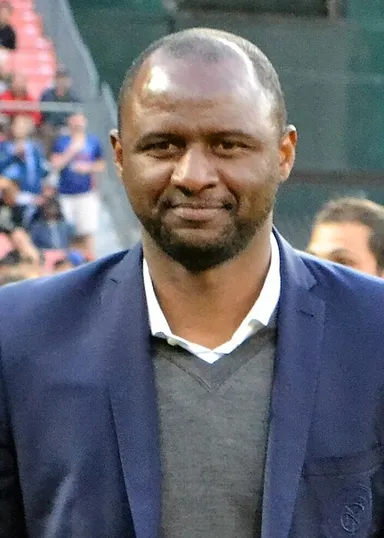 Photo: Simon Heseltine. Source and license in Image credits.
Cannes · AC Milan · Arsenal
1993—2011
Liverpool · LA Galaxy
1998—2016 Photo: Barcex. Source and license in Image credits.
Haarlem · Feyenoord · PSV
1979—1998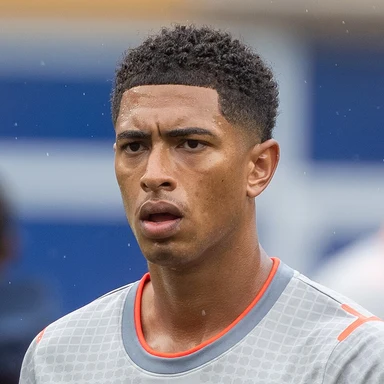 Photo: Bryan Berlin / WikiPortraits. Source and license in Image credits.
Birmingham City · Borussia Dortmund · Real Madrid
2019—PresentStatistics are displayed only within the scope supported by each cited source.
JuventusJuventus Hall of Fame: Pavel NedvědJuventusJuventus: Nedvěd’s final match and eight-season contributionLazioLazio: Nedvěd’s 207 appearances, 51 goals and honoursSparta PragueSparta’s golden era and Nedvěd’s developmentSparta PragueSparta: Nedvěd’s two goals in the 1996 Czech Cup finalFAČRCzech FA: Nedvěd’s domestic league seasonsFAČRCzech FA: 91 senior appearances and 18 goalsRSSSFRSSSF: Nedvěd’s international match registerNational Football TeamsNedvěd: league seasons and alternative international totalRSSSFNedvěd: matches in European club competitionsUEFAUEFA: the versatile two-footed midfielder’s careerUEFAJuventus 3–1 Madrid: the goal and the suspensionUEFAEURO 2004: the Czech comeback against the NetherlandsUEFAEURO 2004: Nedvěd’s semi-final knee injuryUEFANedvěd wins the 2003 Ballon d’OrUEFAUEFA: Juventus lose the 2005 and 2006 league titlesJuventusJuventus: staying for the Serie B rebuildUEFALazio win the 1999 UEFA Super Cup