
The football behind Lothar Matthäus’s ratings
- Progressive carrying
- Elite
- Long-range striking
- Elite
- Repeat effort
- Elite
- Central ball winning
- Excellent
- Decisive distribution
- Excellent
- Aerial specialisation
- Good
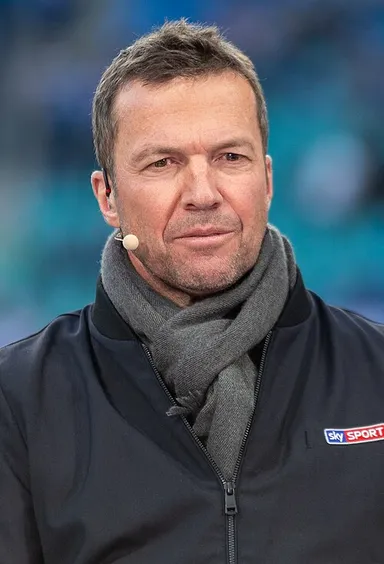 Photo: Steffen Prößdorf. Source and license in Image credits.
Lothar Herbert Matthäus
A commanding midfielder who connected ball winning, powerful carrying and long-range shooting before reinventing himself in a deeper defensive role.
Senior club · all competitions
Completed club records only; not a complete career total.
Active club snapshots and records with another scope are excluded. Assist totals are not combined across incompatible definitions.
Stored archive snapshots, not live counters. Missing values are not zero; records with different scopes are never added together.
G/M = goals ÷ appearances. G+A = goals + assists. Per-90 metrics use documented minutes.
Senior international · all competitions
Germany · senior internationals, 1980–2000
Stored archive snapshots, not live counters. Missing values are not zero; records with different scopes are never added together.
G/M = goals ÷ appearances. G+A = goals + assists. Per-90 metrics use documented minutes.
In context
The 1990 World Cup captain offers a study in complete midfield influence and the different demands of a later libero role.
Reading the game
Lothar Matthäus matters because he expands what a central midfielder can be asked to do. At his peak, winning the ball was the beginning of an attack: he could carry it through the next line, change the direction with a pass or finish the move himself. That sequence made defensive effort and attacking authority parts of the same job. His importance is easier to see in the ground he connected than in a single position on a formation graphic. Inter supplied a demanding club setting for that force, while West Germany’s 1990 World Cup campaign offered its clearest international expression. Later, a deeper defensive role asked him to influence the game from a different starting point. Reading those periods separately prevents a familiar mistake: imagining that the midfield runner and the veteran libero performed identical tasks. This dossier treats his career as an evolution in how one player could direct a team, with the 1989/90 club season and its concluding World Cup forming the shared assessment window.
Historical references support the chronology; tactical explanations are museum editorial analysis.
Historical references: Inter Hall of Fame: Lothar Matthäus ↗ · Bayern remembers Matthäus in midfield and as libero ↗ · FIFA: Matthäus against Yugoslavia in 1990 ↗
Career
| Period | Club | Apps | Goals | G/M |
|---|---|---|---|---|
| 1979—1984 | Borussia MönchengladbachFive Bundesliga seasons total 162 appearances and 36 goals. This league subset excludes domestic cups and European football; earlier amateur football is outside the professional series. Senior club · league only | 162 | 36 | 0.22 |
| 1984—1988 | Bayern MunichThe first Bayern spell totals 113 Bundesliga appearances and 57 goals. The 1986/87 row follows the DFB’s fourteen goals, not NFT’s conflicting seventeen. Senior club · league only | 113 | 57 | 0.50 |
| 1988—1992 | Inter MilanInter’s Serie A subset is 115 appearances and forty goals. The club’s 153/53 all-competition record includes this subset, so the two figures must not be added. Senior club · league only Senior · #10 | 115 | 40 | 0.35 |
| 1992—2000 | Bayern MunichThe return spell adds 189 Bundesliga appearances and 28 goals. His 1999/00 row ends with the March 2000 departure for the MetroStars. Senior club · league only | 189 | 28 | 0.15 |
| 2000—2000 | MetroStarsThe American row covers sixteen regular-season appearances and no goals. MLS play-offs and cup matches are outside this selected league series. Senior club · league only | 16 | 0 | 0.00 |
Stored archive snapshots, not live counters. Missing values are not zero; records with different scopes are never added together.
G/M = goals ÷ appearances. G+A = goals + assists. Per-90 metrics use documented minutes.
Honours
Bayern Munich · league
Bayern Munich · domestic cup
Bayern Munich · domestic cup
Bayern Munich · domestic cup
Bayern Munich · continental
Inter Milan · league
Inter Milan · domestic cup
Inter Milan · continental
Germany · world
Germany · continental
Lothar Matthäus · individual
Lothar Matthäus · individual
Lothar Matthäus · individual
Lothar Matthäus · individual
Story
Career chapter
The professional story begins at Borussia Mönchengladbach in 1979, before a first Bayern spell starting in 1984. These years matter as the construction of a midfield skill set, rather than a prologue waiting for international fame. Regular league football made carrying, passing and defensive recovery recurring responsibilities. At Bayern, scoring became a substantial part of that contribution: the league record shows a midfielder capable of reaching the end of attacks as well as starting them. The move to Italy would change the competitive setting, but the essential question was already visible: how could his forward force remain connected to the team behind him?
Historical references: DFB data centre: Matthäus career and season records ↗ · Bundesliga: the great midfielders ↗
Career chapter
At Inter, Matthäus helped win the 1988/89 league title and subsequently the 1990/91 UEFA Cup. Between those successes came the defining international summer. He captained West Germany to the 1990 World Cup, scoring four times across seven appearances. The two goals against Yugoslavia offer a useful viewing guide: look at the preparation and the different shooting solutions, not just the power. He was a central midfielder in that team, not its libero. The final also belongs to the collective: Andreas Brehme scored the winning penalty. Individual recognition followed across two distinct awards, the 1990 Ballon d’Or and the inaugural FIFA World Player award in 1991.
Historical references: Inter player archive: Matthäus ↗ · RSSSF: Lothar Matthäus international appearances ↗ · FIFA: two goals, two feet against Yugoslavia ↗ · FIFA interview: Matthäus recalls the 1990 final ↗ · FIFA: the inaugural World Player award winner ↗
Career chapter
Matthäus returned to Bayern in August 1992 and gradually became associated with a deeper libero role. The change deserves its own description: reading danger from behind the midfield and choosing the first forward pass differ from repeatedly carrying through it. Bayern won the 1995/96 UEFA Cup during this second spell. The 1999 Champions League final then left a more painful image. He started in the defensive line and was replaced by Thorsten Fink before Manchester United’s late comeback. That sequence is a match fact, not proof that the substitution alone caused defeat. It also explains why this veteran version cannot simply be folded into the 1990 midfield rating.
Historical references: Bayern Hall of Fame: Lothar Matthäus ↗ · Bayern remembers Matthäus in midfield and as libero ↗ · Bayern historical week: the August 1992 return ↗ · UEFA: United’s late comeback against Bayern in 1999 ↗ · UEFA Champions League finals: results and line-ups ↗
Career chapter
The final professional year crossed two calendars. Matthäus played part of Bayern’s 1999/00 campaign before joining the MetroStars in 2000; the American league row here covers the regular season only. His Germany career also continued to Euro 2000, ending with 150 senior appearances. Longevity brought extraordinary experience, but it did not make this final version identical to the forceful midfielder of a decade earlier. The page therefore ends the professional sequence in 2000 and keeps earlier amateur football and later ceremonial returns outside its totals. The closing chapter is best read as the boundary of a long competitive career, rather than another peak assembled from reputation.
Historical references: DFB data centre: Matthäus career and season records ↗ · RSSSF: Lothar Matthäus international appearances ↗ · National Football Teams: Matthäus club seasons ↗ · MLS: Lothar Matthäus player statistics ↗
Profile
Box-to-Box Midfielder
Also plays · Holding Midfielder
The shared 1989/90 window includes the club season and its concluding 1990 World Cup. Matthäus drives play from central midfield through recovery, carrying and purposeful distribution, with powerful shooting changing the defender’s choices. The later libero stage is described separately and does not supply extra defensive experience to this peak assessment.
Recovery into forward carrying
Powerful shooting with both feet
Midfield range and repeat effort
Decisive passing after the regain
Illustrative role zones · not tracking data
His most characteristic midfield action links a recovery to a forward decision. A tackle can remove an opponent, but the carry that follows can remove a second line and force the defence to turn. The useful detail is the change of pace after contact: he does not need a long sequence of feints when an open lane appears. This is an interpretation of the peak midfielder, supported by the 1990 Yugoslavia footage, rather than a claim that every possession demanded a solo run.
The shot matters because it changes what defenders must protect. If they retreat to contain the run, he can strike before entering the penalty area; if they step out, the next pass becomes available. His two goals against Yugoslavia demonstrate that the threat was not confined to one foot or one approach. Powerful shooting is therefore part of the space he creates for others. It should not be confused with the close control of a specialist winger or the penalty-box craft of a centre-forward.
A complete midfield contribution requires a return journey. The same player who carries forward must recognise whether to press the immediate receiver, close a central lane or recover alongside a teammate. Matthäus’s energy gives that reading a physical expression. The assessment rewards the capacity to connect those jobs, while leaving room for team structure: no individual covers the whole pitch at once. A forward surge is valuable when its timing, the support around it and the next defensive response remain connected.
In the later defensive role, influence began from a clearer view of the players ahead. Holding a position, covering a teammate and deciding when to release the ball could matter more than reaching the opposing box. The passing quality survived in a different tactical job, with less reason to reproduce the old running pattern. This stage belongs in the career story and the 1998/99 representative version. It is deliberately kept separate from the shared 1989/90 rating, so late-career experience does not become an extra attribute bonus for the younger player.
Historical references: Bayern remembers Matthäus in midfield and as libero ↗ · FIFA: Matthäus against Yugoslavia in 1990 ↗ · FIFA: two goals, two feet against Yugoslavia ↗ · FIFA: a record-breaking champion turns 60 ↗ · Bundesliga: the great midfielders ↗ · UEFA Champions League finals: results and line-ups ↗
Reading the game
| Era / team | Primary Role | Tactical Character |
|---|---|---|
| 1979–1984Borussia Mönchengladbach | The Bundesliga foundation | Regular midfield work develops the link between recovery and forward play. |
| 1984–1988Bayern Munich | An increasingly dangerous scorer | The first Bayern spell brings sustained midfield scoring alongside progression. |
| 1988–1992Inter Milan / West Germany | The commanding midfield peak | Inter and the 1990 World Cup reveal a powerful two-way central midfielder. |
| 1992–1996Bayern Munich | A gradually deeper responsibility | The Bayern return leads toward directing play from behind the midfield. |
| 1996–2000Bayern Munich / Germany | The veteran defensive organiser | The libero stage changes his starting position and the space he protects. |
Historical references: Inter Hall of Fame: Lothar Matthäus ↗ · Bayern remembers Matthäus in midfield and as libero ↗ · Bayern historical week: the August 1992 return ↗ · DFB data centre: Matthäus career and season records ↗
Reading the game
The attraction is the continuity between actions. A recovery becomes a carry, and the carry becomes a decision near goal. Watch how quickly opponents must change from attacking to running backwards. This sequence explains his influence more clearly than treating tackling, pace and shooting as isolated strengths.
The two-footed threat makes a simple defensive instruction less reliable. Showing him away from his stronger side does not automatically end the danger. The 1990 Yugoslavia goals provide the example; the broader lesson is to watch body preparation and the available target, rather than awarding identical finishing ability from every angle.
Captaincy gives the 1990 story a visible symbol, but the footballing substance lies in taking responsibility between the lines and through changes of possession. The final still depended on teammates performing their own jobs, including Brehme’s penalty. Leadership is read here as contribution within a collective, not ownership of every decisive action.
The later libero role demonstrates adaptation without erasing change. A player once associated with surging through midfield could organise from behind it. The continuity lay in reading the game and distributing the ball; the difference lay in the space he protected and the risks attached to leaving his position.
Historical references: Bayern remembers Matthäus in midfield and as libero ↗ · FIFA: Matthäus against Yugoslavia in 1990 ↗ · FIFA: two goals, two feet against Yugoslavia ↗ · FIFA interview: Matthäus recalls the 1990 final ↗
Reading the game
Box-to-Box Midfielder
His first Italian league season offers the club reference for driving midfield play within a championship team. It is the version to watch for the relationship between forward force and collective balance. The league row is 32 appearances and nine goals; the trophy belongs to the whole side.
Box-to-Box Midfielder
The shared assessment window joins the 1989/90 club campaign to its concluding 1990 World Cup. Carrying, long shooting and recovery work form the central argument. The international evidence sharpens the interpretation of that period; it does not add late-career libero qualities or the following season’s UEFA Cup performances.
Libero
This representative version begins deeper and asks different questions: how to protect the line, read the next threat and start possession from defence. The Champions League final provides a concrete positional reference. It is a separate career portrait, rather than a second source of peak physical attributes for the midfield rating.
Historical references: Inter Hall of Fame: Lothar Matthäus ↗ · FIFA: Matthäus against Yugoslavia in 1990 ↗ · UEFA Champions League finals: results and line-ups ↗
Statistics
| Season | Club | Apps | Goals | G/M |
|---|---|---|---|---|
| 2000 | MetroStars Senior club · league only | 16 | 0 | 0.00 |
| 1999/00 | Bayern Munich Senior club · league only | 15 | 1 | 0.07 |
| 1998/99 | Bayern Munich Senior club · league only | 25 | 1 | 0.04 |
| 1997/98 | Bayern Munich Senior club · league only | 25 | 3 | 0.12 |
| 1996/97 | Bayern Munich Senior club · league only | 28 | 1 | 0.04 |
| 1995/96 | Bayern Munich Senior club · league only | 19 | 1 | 0.05 |
| 1994/95 | Bayern Munich Senior club · league only | 16 | 5 | 0.31 |
| 1993/94 | Bayern Munich Senior club · league only | 33 | 8 | 0.24 |
| 1992/93 | Bayern Munich Senior club · league only | 28 | 8 | 0.29 |
| 1991/92 | Inter Milan Senior club · league only | 27 | 4 | 0.15 |
Stored archive snapshots, not live counters. Missing values are not zero; records with different scopes are never added together.
G/M = goals ÷ appearances. G+A = goals + assists. Per-90 metrics use documented minutes.
The 22 selected professional league rows total 595 appearances and 161 goals: Bundesliga 464/121, Serie A 115/40 and MLS regular season 16/0. German rows follow the DFB; the 1986/87 Bayern tally is fourteen goals, differing from NFT’s seventeen. Cup matches, MLS play-offs, early amateur football and later ceremonial returns are excluded. The final Bayern and MetroStars rows overlap in calendar year but represent separate clubs. Unknown assists remain null.
Club competitions
| Competition | Apps | Goals | G/M |
|---|---|---|---|
BundesligaBundesliga · Gladbach and both Bayern spellsThe complete Bundesliga subset combines Gladbach 162/36 and Bayern 302/85. These figures are already included in the season table. | 464 | 121 | 0.26 |
Serie ASerie A · Inter, 1988–1992League matches only; Inter’s broader 153/53 total must not be added. | 115 | 40 | 0.35 |
Major League SoccerMLS · 2000 regular seasonRegular season only, excluding play-offs and cups. | 16 | 0 | 0.00 |
UEFA CupUEFA Cup · 1990/91 onlyInter’s archive lists twelve appearances and six goals in the title campaign. This is one season, not his European career total. | 12 | 6 | 0.50 |
Stored archive snapshots, not live counters. Missing values are not zero; records with different scopes are never added together.
G/M = goals ÷ appearances. G+A = goals + assists. Per-90 metrics use documented minutes.
International
International career
A 150-cap, 23-goal senior career spanning West Germany and unified Germany. He captained the 1990 World Cup winners and appeared in five World Cups. The 1980 European title came with one substitute appearance; it was a different responsibility from his later captaincy.
Senior international · tournament splits
| Competition | Apps | Goals | G/M |
|---|---|---|---|
FIFA World CupWorld Cup finals · five editions, 1982–1998Five finals tournaments, excluding qualification. This historical appearance total is not described as a current world record. | 25 | 6 | 0.24 |
UEFA European ChampionshipEuropean Championship finals · 1980, 1984, 1988, 2000Four editions. He did not play at Euro 1996, so Germany’s title that year is not part of his honours. | 11 | 1 | 0.09 |
FIFA Confederations CupConfederations Cup · 1999Three appearances in the 1999 group stage; these are included in the senior career record. | 3 | 1 | 0.33 |
Stored archive snapshots, not live counters. Missing values are not zero; records with different scopes are never added together.
G/M = goals ÷ appearances. G+A = goals + assists. Per-90 metrics use documented minutes.
Reading the game
Matthäus leaves a model of midfield authority built from movement, responsibility and the ability to make an action count at either end. The lesson is not that every midfielder should attempt everything. It is that recovery, progression and finishing can reinforce one another when the player understands the moment to change gears. His later work behind the midfield adds another lesson: experience can alter where influence begins without preserving every physical advantage of youth. The World Cup captain, the Inter title winner and the Bayern veteran therefore belong to one career but require different tactical descriptions. His record also needs its boundaries. Five World Cups and 150 senior internationals establish remarkable continuity; they should not be presented as a current claim to every appearance record. Two European Cup final defeats remain part of the story alongside domestic success and UEFA Cup victories. Keeping those absences visible makes the achievement more precise. Above all, his legacy offers a way to watch the complete midfielder: follow the player after the tackle, after the pass and after possession changes, when reputation gives way to the next responsibility.
Historical references: Bayern Hall of Fame: Lothar Matthäus ↗ · RSSSF: Lothar Matthäus international appearances ↗ · FIFA: a record-breaking champion turns 60 ↗ · UEFA: United’s late comeback against Bayern in 1999 ↗
Archive
Box-to-Box Midfielder · editorial peak 1989—1990
Jupp Heynckes · Udo Lattek · Giovanni Trapattoni · Franz Beckenbauer · Berti Vogts · Erich Ribbeck · Ottmar Hitzfeld · Octavio Zambrano
Oliver Kahn— Overlapping Bayern Munich era · Karl-Heinz Rummenigge— Overlapping Germany era
Trapattoni’s Inter — Inter Milan · Hitzfeld’s European response — Bayern Munich

Bayern Munich · New York Cosmos · Hamburger SV
1964—1983 Photo: Real Madrid (YouTube channel). Source and license in Image credits.
Bayern Munich · Bayer Leverkusen · Real Madrid
2007—2024 Photo: Bryan Berlin / WikiPortraits. Source and license in Image credits.
Schalke 04 · Bayern Munich
2006—Present
Liverpool · LA Galaxy
1998—2016 Photo: Barcex. Source and license in Image credits.
Haarlem · Feyenoord · PSV
1979—1998 Photo: Bryan Berlin / WikiPortraits. Source and license in Image credits.
Birmingham City · Borussia Dortmund · Real Madrid
2019—PresentStatistics are displayed only within the scope supported by each cited source.
InterInter Hall of Fame: Lothar MatthäusInterInter player archive: MatthäusInterInter celebrates Matthäus at 65InterInter Hall of Fame: the elected playersFC BayernBayern Hall of Fame: Lothar MatthäusFC BayernBayern remembers Matthäus in midfield and as liberoFC BayernBayern historical week: the August 1992 returnDFBDFB data centre: Matthäus career and season recordsDFBDFB: World Cup hero and record international turns 65RSSSFRSSSF: Lothar Matthäus international appearancesNational Football TeamsNational Football Teams: Matthäus club seasonsFIFAFIFA: Matthäus against Yugoslavia in 1990FIFAFIFA: two goals, two feet against YugoslaviaFIFAFIFA interview: Matthäus recalls the 1990 finalFIFAFIFA: a record-breaking champion turns 60FIFAFIFA: the inaugural World Player award winnerMLSMLS: Lothar Matthäus player statisticsBundesligaBundesliga: the great midfieldersUEFAUEFA: United’s late comeback against Bayern in 1999UEFAUEFA Champions League finals: results and line-ups